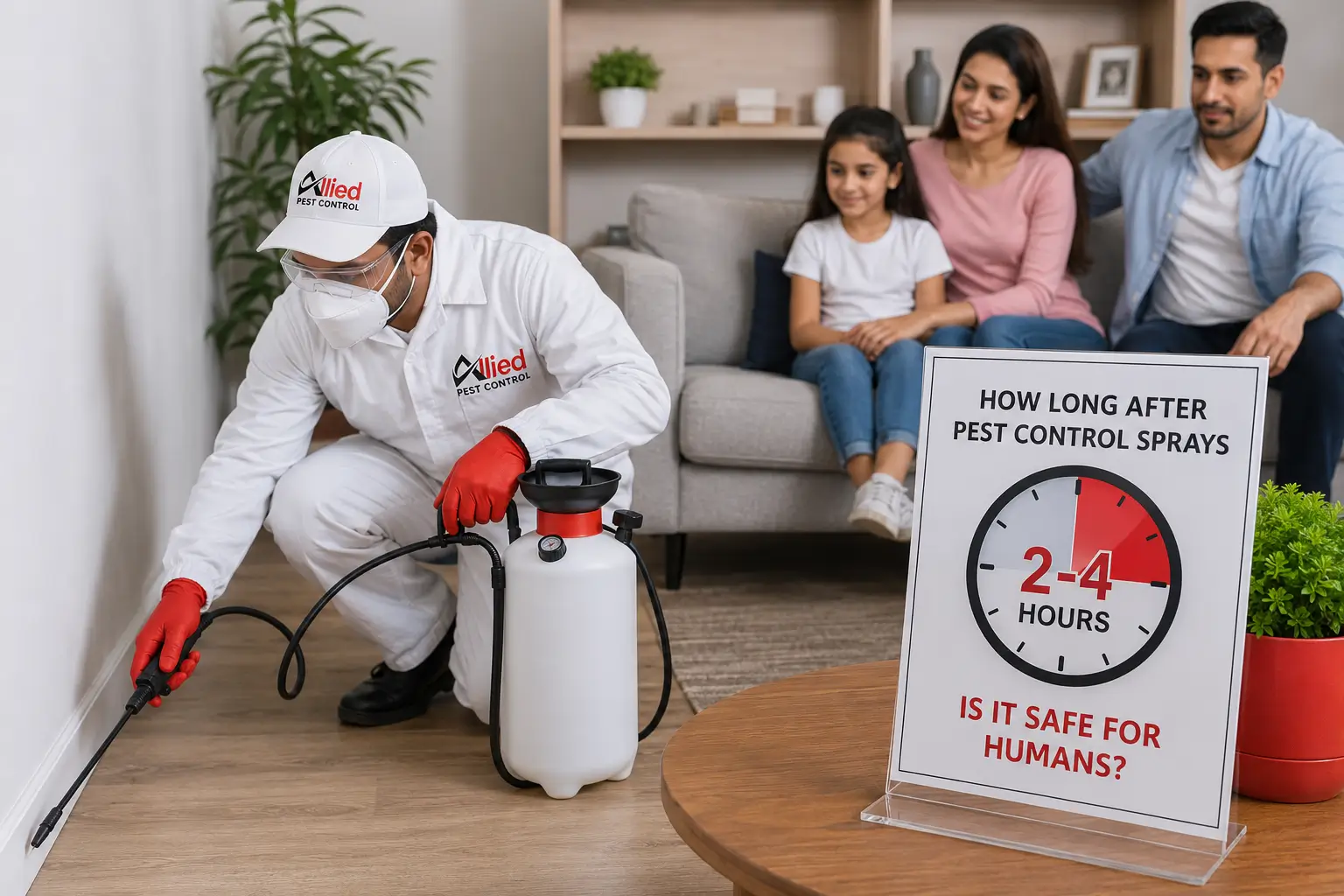
Pest control services in Dubai use approved chemicals to eliminate cockroaches, ants, bed bugs, and rodents from homes. Most sprays dry within 1 to 4 hours, and rooms become safe once surfaces dry and the space is ventilated. Waiting time depends on the chemical, treatment area, and airflow.
Quick Answer
Most homes are safe to re-enter 2 to 4 hours after pest control spraying, once the product dries and the room is ventilated. Infants, pregnant women, and elderly adults should wait 6 to 8 hours.
What Happens During Pest Control Spraying?
How treatments are applied
Technicians spray liquid insecticides along baseboards and cracks, place gel baits in corners, and add dust into wall voids to target pest entry points.
What happens after the spray dries
The active ingredient bonds to the surface once the liquid evaporates. This dried residue keeps killing pests for weeks, while becoming far safer to touch.
Why drying time matters
Wet pesticide transfers easily to skin, shoes, and pet paws. Waiting for it to dry reduces contact and stops chemicals from spreading to other rooms.
Types of Pest Control Chemicals Used by Professionals
Professional pest control services use carefully selected chemicals used for effective pest control, with each product having its own safety profile and drying time.
| Chemical | Common Use | Re-entry Time |
| Pyrethroids | Cockroaches, ants | 2–4 hours |
| Pyrethrins | Flying insects | 1–2 hours |
| Neonicotinoids | Termites, ants | 2–4 hours |
| IGRs | Fleas, roach breeding | 2–3 hours |
| Organophosphates | Legacy treatments | 4–6 hours |
| Boric Acid | Cockroaches, ants | Minimal |
| Fipronil | Termites, ants | 3–4 hours |
| Hydramethylnon | Ant/roach baits | Minimal |
Pyrethroids
Pyrethroid insecticides, such as permethrin, disrupt insect nerve function and dry within 2 to 4 hours at low mammalian toxicity.
Pyrethrins
Pyrethrins come from chrysanthemum flowers and break down quickly, making rooms safe within 1 to 2 hours.
Neonicotinoids
Neonicotinoids give long-lasting termite and ant control with low human toxicity at labeled doses.
Insect Growth Regulators (IGRs)
Growth regulators stop larvae from maturing instead of killing pests outright, carrying minimal risk to people and pets.
Organophosphates (older products)
Organophosphates act on an enzyme shared by insects and mammals, making them more toxic, so technicians now use them sparingly outdoors.
Boric Acid
Boric acid pest control damages an insect’s exoskeleton and stays low-toxicity in small residential amounts.
Fipronil
Fipronil insecticide disrupts pest nervous systems and stays effective for months after application.
Hydramethylnon
Hydramethylnon works as a slow bait poison sealed inside stations, limiting contact with household members.
Gel baits vs liquid sprays
Gel baits stay contained in cracks and need no waiting period. Liquid sprays cover open surfaces and need 2 to 4 hours to dry.
Dust formulations
Dust formulations settle into wall voids and carry minimal inhalation risk when applied correctly.
How Pest Control Chemicals Work
Contact insecticides
Contact insecticides kill pests the moment the chemical touches their body.
Stomach poisons
Stomach poisons act after a pest ingests bait, usually within 24 to 72 hours.
Residual insecticides
Residual insecticides bond to surfaces and keep working for 30 to 90 days.
Repellents
Repellents push pests away from treated zones without necessarily killing them.
Non-repellent insecticides
Non-repellent insecticides carry no detectable odor, letting pests carry the chemical back to the colony.
Growth regulators
Growth regulators block reproduction over several weeks, reducing pest populations gradually.
Bait systems
Bait systems pair a food attractant with slow-acting poison for colony-wide control.
Is Pest Control Spray Harmful to Humans?
Short-term exposure to wet pesticides can cause skin irritation, headache, or mild respiratory irritation, which usually fades within hours in fresh air. Long-term concerns arise only from repeated, heavy exposure without ventilation.
Exposure becomes dangerous with ingestion, prolonged skin contact, or hours of fume exposure indoors. Regulatory agencies approve residential pesticides as low-risk when technicians follow label instructions and drying times.
Who Should Be Extra Careful After Pest Control?
Some household members need longer than the standard 2 to 4 hours.
Babies and toddlers
How long after pest control can I bring the baby home? Babies and toddlers should wait 6+ hours, since they crawl on floors and mouth objects.
Pregnant women
Pest control while pregnant needs extra caution, so pregnant women should wait 6 to 8 hours before entering treated rooms as a precaution.
Elderly adults
Elderly adults should wait until all odor clears due to reduced respiratory capacity.
People with asthma
People with asthma should ventilate rooms for 4+ hours before entry.
Allergy sufferers
Allergy sufferers should wait for the spray to fully dry.
People with weakened immune systems
People with weakened immune systems should follow the longest recommended waiting period.
How Long Should You Stay Away After Pest Control?
Homeowners should stay away from treated areas for 2 to 4 hours after standard indoor spraying, and up to 24 hours after fogging or termite fumigation. Allied Pest Control’s residential treatment lists for pest control cost in Dubai.
Factors That Affect How Long You Should Stay Out
Several conditions change how long a room needs before it’s safe. Fast-drying pyrethrins need only 1 to 2 hours, while organophosphates need up to 6, and indoor treatments dry slower than outdoor ones due to limited airflow. Higher spray concentrations add 1 to 2 extra hours.
Ventilation cuts drying time by up to 50%, while high humidity slows evaporation and extends the wait. Larger treated areas add another 1 to 2 hours to the safe re-entry window.
Typical Waiting Times for Different Pest Treatments
- Cockroach treatment: 2–4 hours
- Ant treatment: 2–3 hours
- Bed bug treatment: 4–6 hours
- Flea treatment: 3–4 hours, plus vacuuming after 24 hours
- Mosquito treatment (outdoor): 30–60 minutes
- Termite treatment: 24 hours
- Rodent baiting: no restriction, since bait stays sealed
- Wasp treatment: 1–2 hours
Signs That It Is Safe to Re-enter Your Home
- The spray has completely dried on treated surfaces.
- No strong chemical odor remains in the air.
- Rooms have been ventilated for at least 1 hour.
- The technician gives official clearance.
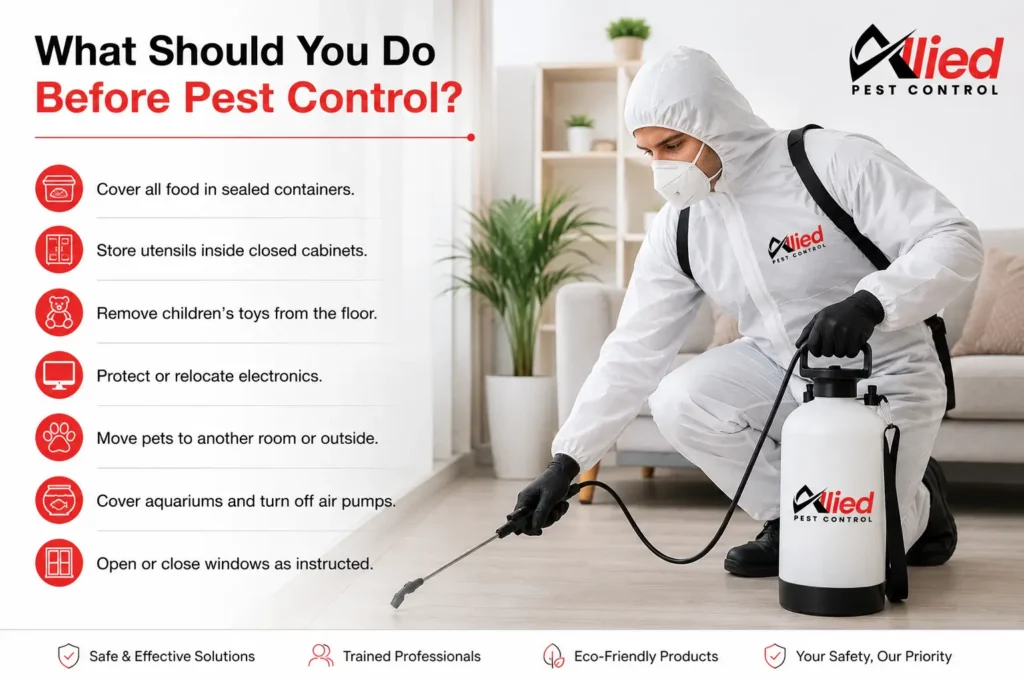
What Should You Do Before Pest Control?
- Cover all food in sealed containers.
- Store utensils inside closed cabinets.
- Remove children’s toys from the floor.
- Protect or relocate electronics.
- Move pets to another room or outside.
- Cover aquariums and turn off air pumps.
- Open or close windows as instructed.
What Should You Do After Pest Control?
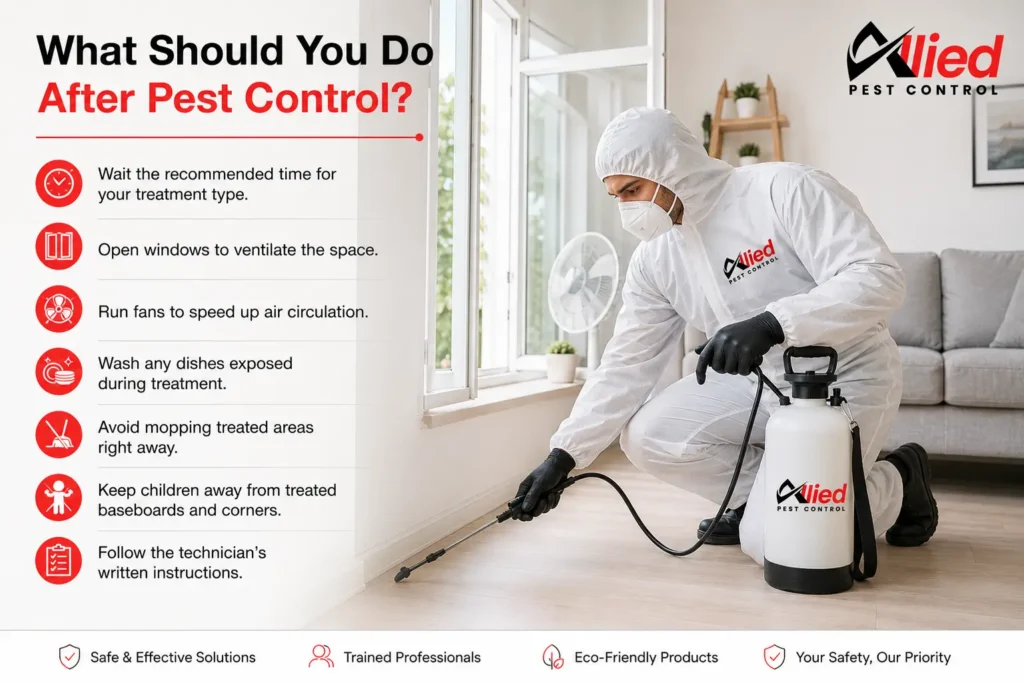
- Wait the recommended time for your treatment type.
- Open windows to ventilate the space.
- Run fans to speed up air circulation.
- Wash any dishes exposed during treatment.
- Avoid mopping treated areas right away.
- Keep children away from treated baseboards and corners.
- Follow the technician’s written instructions.
How Often Should Pest Control Be Done?
Most homes benefit from pest control every 3 months. Read our guide on how often should pest control be done for infestation-specific schedules. Properties with heavy infestations need monthly visits for the first 3 months, then quarterly service.
Should You Clean Your House After Pest Control?
What you can clean immediately
Counters and dining surfaces can be wiped down right away, since technicians avoid spraying food-contact areas.
What should not be cleaned?
Baseboards and corners should stay unwiped for about 2 weeks to preserve the chemical barrier.
When to mop floors
Avoid mopping floors for 24 to 48 hours after treatment.
When to vacuum
Vacuum flea-treated carpets after 24 hours to remove dead insects and eggs.
Why does cleaning too soon reduce effectiveness
Cleaning too soon strips the residue from surfaces, cutting the treatment’s working life from weeks down to days.
How Long Does Pest Control Spray Keep Working?
Residual sprays
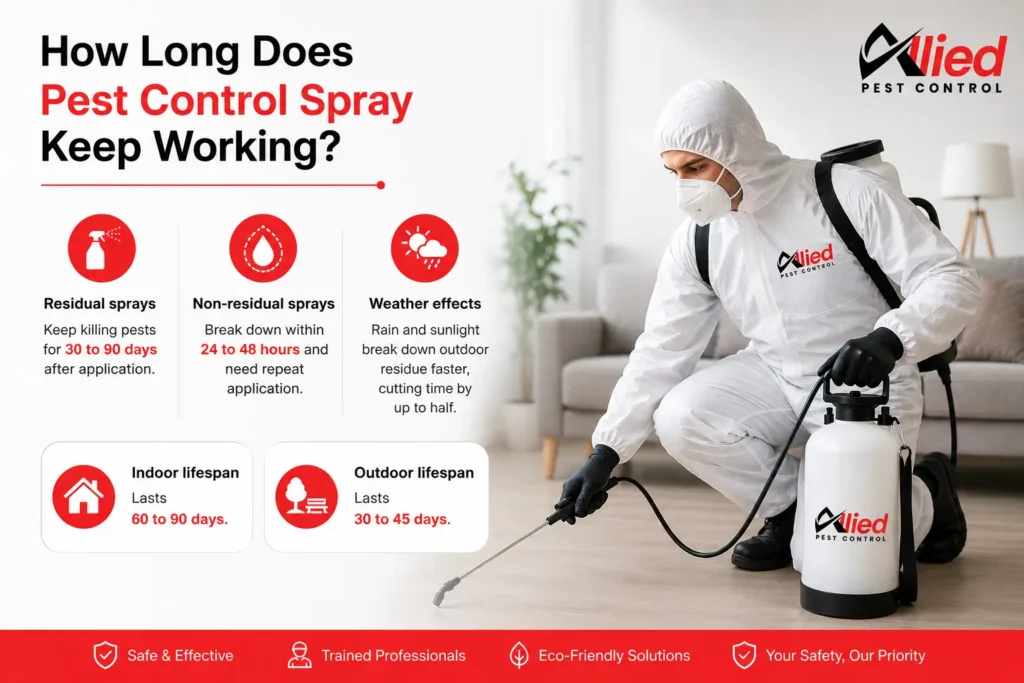
Residual sprays keep killing pests for 30 to 90 days after application.
Non-residual sprays
Non-residual sprays, like pyrethrins, break down within 24 to 48 hours and need repeat application.
Weather effects
Rain and direct sunlight break down outdoor residue faster, cutting effective duration by up to half.
Indoor lifespan
Indoor treatments typically last 60 to 90 days.
Outdoor lifespan
Outdoor treatments last 30 to 45 days before needing reapplication.
What If Someone Is Exposed to Pest Control Spray?
Mild symptoms
Mild symptoms, such as skin irritation or a headache, usually resolve within a few hours in fresh air.
When to seek medical help
Seek medical help immediately for difficulty breathing, chest tightness, or vomiting that doesn’t improve.
First aid for skin exposure
Wash the affected skin with soap and water for 15 minutes.
Eye exposure
Flush the eyes with clean water for 15 minutes and seek care if irritation continues.
Inhalation
Move to fresh air right away and monitor breathing.
Accidental ingestion
Call poison control immediately and do not induce vomiting unless instructed.
Natural and Low-Toxicity Pest Control Alternatives
Diatomaceous earth
Diatomaceous earth dehydrates insects on contact with minimal human risk.
Boric acid
Boric acid stays low-toxicity in bait form for cockroach and ant control.
Essential oils
Essential oils like peppermint repel pests naturally, though weaker than chemical sprays.
Sticky traps
Sticky traps capture insects with zero chemical exposure.
Heat treatments
Heat treatments kill bed bugs above 50°C without any chemicals.
Biological pest control
Biological pest control uses natural predators, such as nematodes, in outdoor spaces.
Integrated Pest Management (IPM)
Integrated Pest Management combines sanitation, exclusion, and targeted treatment to cut overall pesticide use.
How to Choose the Best Pest Control Company in Dubai
Licensed technicians
Choose a company with Dubai Municipality-licensed technicians.
Approved pesticides
Confirm the company uses pesticides approved by the UAE Ministry of Climate Change and Environment.
Transparent safety instructions
A reliable provider gives clear, written safety and re-entry instructions before leaving the property.
Customer reviews
Check verified customer reviews for consistent service quality.
Follow-up services
Pick a company offering free follow-up visits within 30 days. Allied Pest Control’s termite treatment services and residential pest control cover all types of pest control services in Dubai.
Final Thoughts
Safe re-entry depends on drying time, ventilation, and the chemical used. Most homes are safe within 2 to 4 hours, while sensitive groups should wait 6 to 8 hours. Always follow the technician’s instructions and the product label exactly, and prioritize open windows and fully dried surfaces before letting family and pets back inside. Allied Pest Control technicians in Dubai give clear, written re-entry guidance after every service.