Identifying hidden ant nests around your home requires a systematic inspection of walls, floors, and outdoor spaces where ants build colonies. Ant control in Dubai is critical because the warm climate accelerates colony growth year-round. Early detection stops infestations before they spread to multiple rooms or structural areas.
Quick Answer to Identify Hidden Ant Nests
Locate ant trails and follow them to entry points. Inspect wall voids, soil near foundations, and wooden structures for nest signs. Tap hollow-sounding walls and look for frass, shed wings, or moist soil mounds. Act within 24–48 hours of first sighting.
Identifying Hidden Ant Nests Before It Spreads
Ants leave behind clear physical evidence before a full infestation takes hold. Recognizing these signs early gives homeowners a 3–5 day advantage before colony numbers double.
Key warning signs of hidden ant nests:
- Ant trails along baseboards or countertops: worker ants follow chemical pheromone paths to food sources in straight, repeating lines
- Frass deposits: carpenter ants push sawdust-like wood shavings out of nest galleries; these appear as small piles near wood structures
- Rustling sounds in walls: large colonies (500+ ants) produce faint crackling sounds inside wall cavities, especially at night
- Shed wings near windowsills: discarded wings from reproductive ants (swarmers) signal a mature colony nearby
- Soil mounds in garden beds: fire ants and pavement ants build dome-shaped mounds 5–10 cm high in loose soil
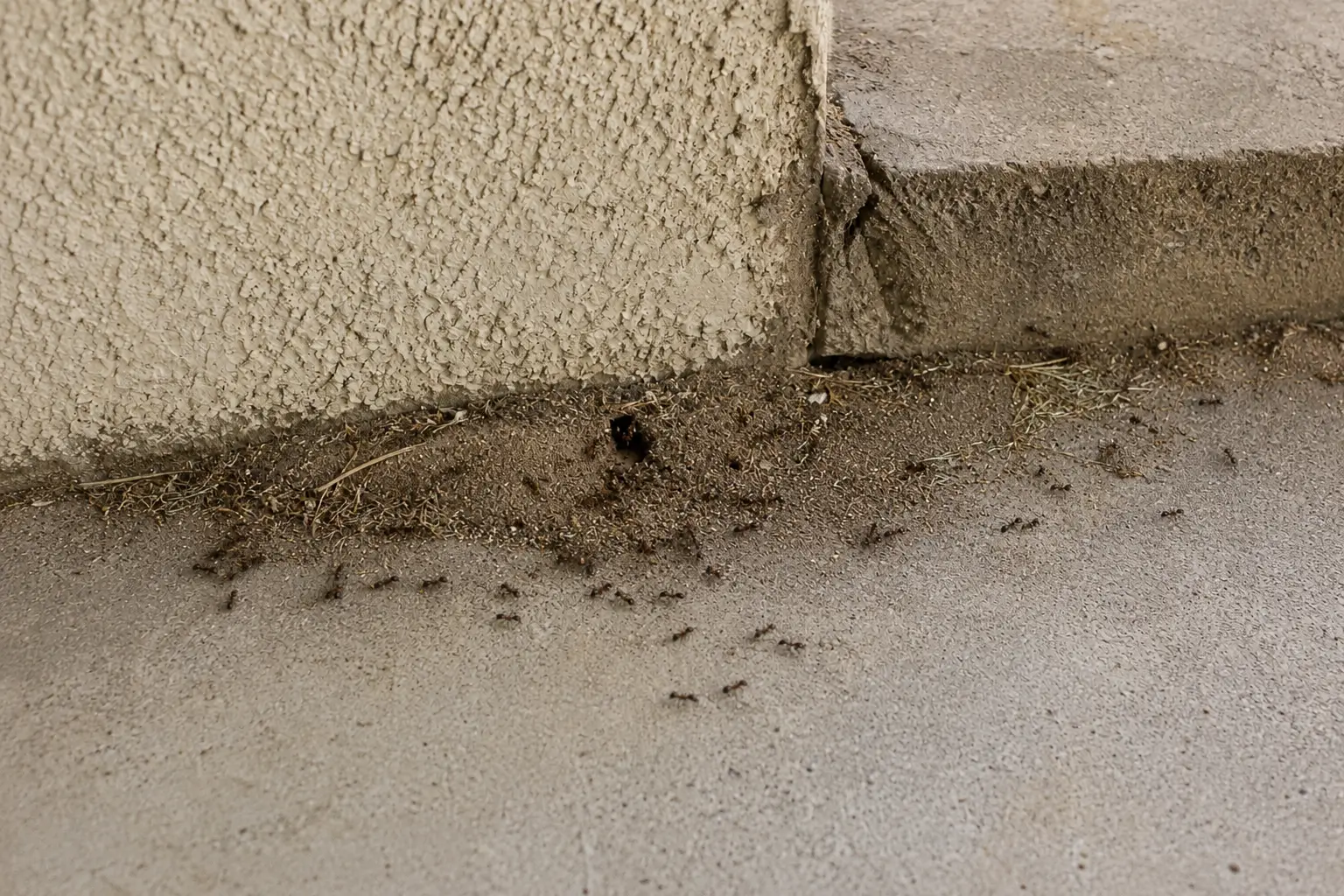
Follow active ant trails for 3–5 minutes. Worker ants always return to the nest. This direct observation method locates nests within 1–2 meters of the visible trail.
What to Do When You Find a Hidden Ant Nest
Allied Pest Control specializes in professional ant control in Dubai and recommends a structured response the moment a nest is located. Acting immediately with the right method prevents colony splitting, which causes ants to scatter and form multiple satellite nests. Here is the step-by-step process explained below.
Step 1: Confirm the Nest Location
Press your ear to the wall or floor near the suspected area. A hollow knock indicates a void where ants build galleries. Use a flashlight to inspect cracks, gaps behind appliances, and soil disturbances near exterior walls. Document the exact location before treatment.
Step 2: Identify the Ant Species
Treatment effectiveness depends entirely on species identification. The three most common ant species in Dubai homes are:
| Species | Nest Location | Colony Size | Threat Level |
| Pharaoh Ant | Wall voids, insulation | 10,000–300,000 | High |
| Carpenter Ant | Moist wood, roof timbers | 3,000–10,000 | High (structural) |
| Argentine Ant | Soil, under slabs | 100,000+ | High |
| Fire Ant | Outdoor soil, lawns | 20,000–500,000 | Severe (sting risk) |
| Pavement Ant | Under concrete slabs | 3,000–5,000 | Medium |
Pharaoh ants require bait-only treatment. Using sprays on pharaoh ant nests triggers “budding,” where the colony splits into dozens of new nests.
Step 3: Apply the Correct Bait or Treatment
Place gel bait stations (Advion Ant Gel or Maxforce FC) within 30 cm of active trails. Do not disturb the trail or clean the area before bait placement. Ants must carry the toxicant back to the queen. Bait works in 3–7 days for most species.
For carpenter ant nests in wood, inject Premise 75 WG (imidacloprid) or Temprid SC directly into gallery entry holes using a foam applicator. Seal entry holes after 48 hours.
Step 4: Treat the Perimeter
Apply a non-repellent insecticide (Termidor SC or Transport GHP) along the exterior foundation as a transfer barrier. Non-repellent formulas are invisible to ants, so foragers walk through the treated zone and carry the active ingredient back to the nest. Apply a 30 cm band around the full foundation perimeter.
Step 5: Eliminate Entry Points
Seal all cracks wider than 1 mm using silicone caulk. Fit door sweeps on exterior doors. Replace damaged weather stripping. Ants enter through gaps as small as 0.5 mm, so physical exclusion is a permanent prevention layer alongside chemical treatment.
Step 6: Verify Treatment Success
Monitor bait stations every 48 hours for the first week. Increased ant activity at bait points in days 1–3 is normal; this confirms foragers are feeding. Activity drops 70–90% by days 5–7 in successful treatments. If activity persists beyond 10 days, re-identify the species and switch bait formulation.
Effective Methods to Control Hidden Ant Nests
Three primary methods control hidden ant infestations in residential settings. Each method suits a different nest type and access level.
Summary of Ant Control Methods:
| Task | Method | Frequency | Time Needed |
| Locate nest | Trail tracking + wall tap test | Once at inspection | 20–30 minutes |
| Baiting | Gel bait stations (Advion, Maxforce) | Refresh every 5–7 days | 10 minutes |
| Wood treatment | Foam injection (imidacloprid) | Single application | 30–60 minutes |
| Perimeter spray | Non-repellent barrier (Termidor SC) | Every 90 days | 45–60 minutes |
| Entry sealing | Silicone caulk + door sweeps | Annual inspection | 1–2 hours |
| Professional inspection | Certified pest technician | Every 6 months | 60–90 minutes |
Bait Method: The most effective method for indoor infestations. Slow-acting toxicants (0.01% indoxacarb or 0.001% fipronil) allow worker ants to feed and return to the nest before dying, achieving 95–100% colony elimination within 7–14 days.
Spray Method: Works for outdoor nests with direct access. Drench soil nests with bifenthrin concentrate mixed at 0.1% dilution. Pour 2–3 liters directly into the mound opening for complete colony contact.
Foam Injection: The best method for wall voids and structural galleries. Expanding foam insecticide fills irregular cavities and reaches queens inaccessible to sprays or bait.
Common Areas for Ant Nests Around Your Home
Hidden ant nests often cluster behind kitchen cabinets, beneath sinks, and around window frames where moisture collects. Pest control services areas in Dubai cover all these zones with targeted inspection and treatment.
- Kitchen wall voids: behind refrigerators and dishwashers, where heat and moisture concentrate
- Bathroom subfloor: under tiles where pipe condensation creates permanent moisture
- Roof timbers and attic insulation: carpenter ants prefer undisturbed, slightly moist wood
- Under concrete slabs: pavement ants build extensive networks 5–15 cm below patio surfaces
- Garden soil near foundations: within 50 cm of exterior walls, especially in shaded areas
- Potted plant soil: indoor plants provide moist, warm nesting media for small species
- Behind electrical outlets and switch plates: wall cavities with wire entry points
- Under kitchen and bathroom cabinets: dark, warm, near food and water sources
Inspect each zone during a 30-minute home walkthrough. Use a bright flashlight and a flat-head screwdriver to probe soft wood and check for hollow sounds.
Conclusion
Identifying hidden ant nests requires tracking trails, tapping walls, inspecting moisture zones, and matching treatment to the specific ant species. Ant control in Dubai demands year-round vigilance because temperatures above 30°C keep colonies active year-round. Early action with the right bait or injection method eliminates the queen, which collapses the entire colony within 7–14 days.
For guaranteed results backed by licensed technicians and EPA-approved products, contact Allied Pest Control Dubai’s trusted specialists in residential and commercial ant control in Dubai. Allied Pest Control delivers targeted inspections, species identification, and multi-step treatment plans that permanently eliminate hidden nests.
Frequently Asked Questions (FAQ) About Hidden Ant Control in Dubai
How to find a hidden ant nest?
Finding a hidden ant nest means following active worker trails back to their source. Trails lead to nests within 1–3 meters; look for entry points in walls, soil, or wood at the trail’s origin.
How to find an ant nest indoors?
Finding an indoor ant nest requires tapping walls for hollow sounds and inspecting behind appliances where heat and moisture accumulate. Check under sinks, behind dishwashers, and inside wall voids near kitchens and bathrooms.
What is the hardest ant to get rid of?
The hardest ant to eliminate is the Pharaoh ant because sprays cause the colony to split into multiple satellite nests. Only slow-acting gel baits like Advion or Maxforce FC effectively eliminate the entire pharaoh ant colony.
What attracts ants then kills them?
Gel baits attract ants with food-grade attractants (sugars, proteins) mixed with slow-acting toxicants like indoxacarb or fipronil. Worker ants carry the bait back to the queen, killing the colony from within over 5–10 days.
How to find ant nests in hidden spaces around your house?
Finding ant nests in hidden home spaces means inspecting wall voids, subfloor areas, attic timbers, and soil near the foundation. Use a flashlight, listen for crackling sounds in walls, and follow frass trails or shed wings to pinpoint exact nest locations.