If you’ve invested in rooftop solar panels in Dubai, you already understand the long-term value they bring: lower electricity bills, reduced carbon footprint, and energy independence. What many property owners don’t anticipate, however, is the damage that pigeons and other birds can cause to that investment.
Bird infestations impact business in Dubai, and solar panels are one of the most underreported and underestimated problems facing residential and commercial solar system owners across the UAE. Left unchecked, they can quietly erode your system’s efficiency, create hygiene hazards, and lead to expensive repairs. The good news is that effective, lasting solutions exist.
This guide walks you through everything you need to know about bird-proofing solar panels in Dubai, from understanding why birds are drawn to these systems to choosing the right protection method for your property.
Why Do Birds Nest Under Solar Panels?
To solve any problem effectively, you first need to understand what’s driving it. Birds, pigeons in particular, aren’t randomly choosing your solar array. They’re making a calculated decision based on survival instincts.
Here’s why the underside of a solar panel is practically a five-star hotel for urban birds:
- Shade and cooling: Dubai’s sun is brutal. The gap between a mounted solar panel and the rooftop creates a cool, shaded pocket that birds instinctively gravitate toward, especially during summer.
- Safety from predators: The enclosed structure makes it difficult for predators to access nests, giving birds a sense of security.
- Shelter from wind and rain: Rooftop panels provide natural protection from the elements, which is ideal for raising chicks.
- Ready-made nesting space: The cavity beneath panels is perfectly sized for pigeons to build nests, often undetected for months.
Once a pair of pigeons settles in, the problem escalates quickly. Pigeons are prolific breeders, and a single nesting pair can produce several broods per year.
Why Pigeon Infestations on Solar Panels Are So Common in Dubai
Dubai’s built environment and climate create ideal conditions for rooftop bird activity. Pigeons thrive in urban settings, and with the rapid growth of villas, apartment complexes, and commercial buildings across the city, there are more rooftop structures than ever before.
Several factors make Dubai especially prone to this issue:
- Year-round warmth means pigeons breed continuously rather than seasonally
- Dense residential communities in areas like Jumeirah, Al Barsha, Arabian Ranches, and Mirdif provide abundant feeding grounds close to roosting sites
- Flat or low-pitched rooftops, common in UAE architecture, are easy for birds to access and navigate
- The rapid adoption of solar panels across villas and commercial buildings has created thousands of new nesting opportunities that didn’t exist five years ago
Municipal pest control campaigns help, but they rarely address individual rooftops. That’s why property owners need a proactive, site-specific approach to bird prevention for solar systems.
6 Warning Signs Your Solar Panels Have a Bird Problem
Many property owners discover the problem only after significant damage has already occurred. Knowing the warning signs can save you thousands of dirhams in maintenance costs.
Watch out for the following:
- Visible droppings around your solar panels are often the first and most obvious sign
- Feathers and nesting material: accumulating around the panel edges or on the roof
- Chirping, cooing, or scratching sounds: coming from the rooftop, particularly in the early morning
- A noticeable drop in energy output: your solar system without any change in sunlight or weather
- Debris and twigs: visible beneath the panels when viewed from the side
- Foul odour: rising from the rooftop area near the array
If you’re experiencing one or more of these, it’s time to act. The longer the problem is ignored, the more entrenched the colony becomes and the more costly the clean-up.
5 Best Ways to Protect Solar Panels from Birds in Dubai
Here are the 5 most effective ways to protect solar panels from birds in Dubai:
1. Solar Panel Bird Mesh
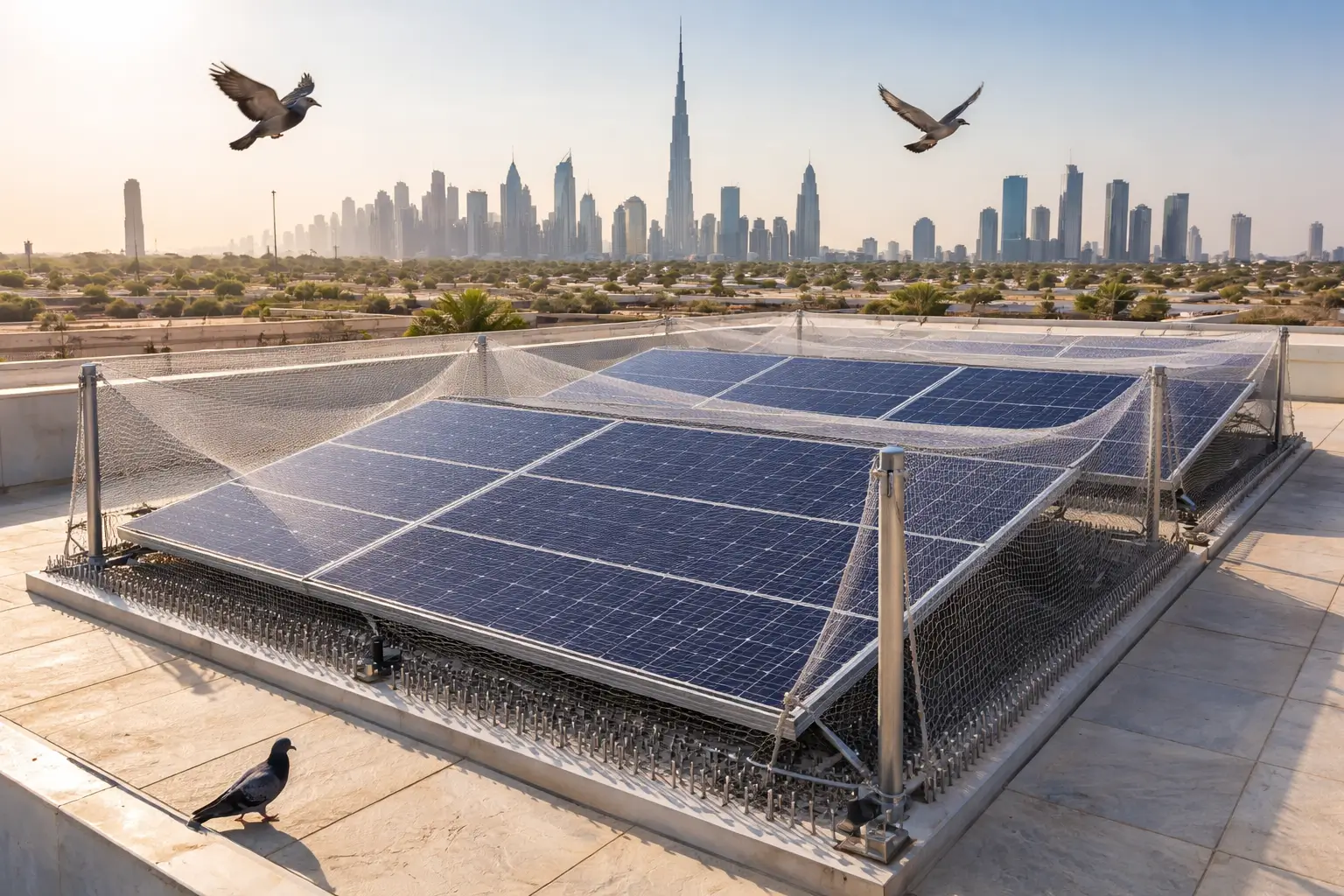
A galvanised or stainless steel mesh is fitted around the perimeter of your solar array, creating a physical barrier that prevents birds from accessing the gap beneath the panels. This is the most widely recommended and durable solution for residential and commercial systems.
2. Perimeter Wire Systems
Thin stainless steel wires are tensioned along the edges of the panels and surrounding rooftop ledges, making it uncomfortable for birds to land and roost without harming them. These systems are nearly invisible from ground level.
3. Rooftop Ledge Spikes
Anti-perch spikes can be installed along parapet walls, ridge lines, and other elevated ledges surrounding the solar array. They discourage landing before birds even reach the panels.
4. Adjacent Structure Protection
Sometimes birds use nearby water tanks, HVAC units, or elevated structures as staging points before moving to the panels. Protecting these adjacent areas is an important part of a complete bird prevention for solar systems strategy.
5. Nesting Deterrent Gel and Visual Repellents
As supplementary measures, anti-roosting gels and visual deterrents (such as reflective tape or predator decoys) can reduce bird activity around the installation. These work best as part of a broader system rather than standalone solutions.
For broader rooftop protection, many property owners also explore bird control in Dubai solutions that address the entire property rather than just the solar array.
Why Solar Panel Bird Mesh Is the Best Long-Term Investment for Dubai Properties
Of all the options available, solar panel bird mesh remains the gold standard and for good reason.
It’s humane: No harm comes to the birds. The mesh simply removes access to the nesting space, encouraging them to relocate without injury.
It’s built for Dubai’s climate: Quality bird mesh is manufactured from UV-resistant, powder-coated or galvanised materials designed to withstand extreme heat, sandstorms, and high humidity without corroding or degrading.
It’s virtually maintenance-free: Once installed correctly by a trained technician, a good mesh system can last 5–10 years without needing significant attention.
It doesn’t affect panel performance: Professional installers use clips and brackets that secure the mesh without drilling into the panel frame or affecting wiring, preserving your manufacturer’s warranty.
It eliminates the problem at the source: Rather than deterring birds after they’ve already arrived, mesh prevents them from ever establishing a foothold.
Professional providers such as Allied Pest Control offer customised bird-proofing solutions for residential and commercial solar systems across Dubai, using industry-grade materials and installation methods aligned with local building standards.
What Happens If You Ignore Bird Damage on Your Solar Panels?
Overlooking rooftop bird protection in Dubai isn’t just a cosmetic issue; it carries real financial and structural risk.
- Reduced solar efficiency: Droppings and debris block sunlight from reaching photovoltaic cells, sometimes reducing output by 15–30%
- Wiring damage: Birds chew through cables and insulation, creating faults in the system that can be expensive to trace and repair
- Hygiene hazards: Pigeon droppings carry bacteria and fungi, including Histoplasma and Salmonella, that pose health risks to occupants
- Nesting material fire risk: Dry twigs and organic debris accumulating near electrical components create a genuine fire hazard
- Structural mess and staining: Acidic droppings corrode metal surfaces and permanently stain roofing materials over time
What begins as a minor inconvenience can escalate into a serious maintenance event. Prevention is always more cost-effective than remediation.
How to Maintain Your Bird-Proofing System in Dubai’s Climate
Once your bird-proofing system is in place, a little routine care goes a long way:
- Inspect the mesh every 6–12 months for any gaps, loose clips, or signs of corrosion, especially after a shamal season
- Clear any debris that accumulates along the mesh perimeter to prevent blockage and moisture build-up
- Schedule an annual solar panel cleaning alongside your bird-proofing inspection for efficiency and hygiene
- Monitor energy output: through your solar inverter’s monitoring app. A sudden, unexplained drop in production often signals a new intrusion
- Act quickly if birds return: a prompt response prevents the situation from re-escalating
If you notice damage to the mesh or signs that birds are finding a new entry point, contact your bird-proofing provider as soon as possible. Most professional installations come with a service guarantee.
Bird-Proofing Solar Panels in Dubai: What Affects the Cost?
The cost of bird-proofing solar panels in Dubai varies depending on several factors:
- Size of the solar installation: larger arrays with more panels naturally require more material and labour
- Roof accessibility and height: certain rooftop configurations require specialised access equipment
- Type of protection system chosen: mesh-only solutions differ in price from comprehensive perimeter wire or multi-method systems
- Existing infestation severity: if a cleaning and sanitisation service is needed before installation, this adds to the overall scope
As a general principle, bird-proofing is a one-time cost that pays for itself quickly by preserving system efficiency and avoiding repair bills. It is almost always significantly less expensive than repairing wiring damage, replacing panels, or conducting a deep clean after years of nesting.
Request a site inspection and quote from a reputable provider before committing. This allows for accurate pricing based on your specific installation.
Final Thoughts: Don’t Let Birds Drain Your Solar Investment
Solar panels are a smart investment for any property owner in Dubai. But without adequate protection, they can quickly become a liability rather than an asset. Pigeons and birds are resourceful creatures, and once they discover the warmth and shelter beneath your panels, they won’t leave easily on their own.
The solution is straightforward: act before the problem takes hold, choose the right protection method, and work with an experienced local provider who understands both the technology and the local bird behaviour patterns.
Frequently Asked Questions About Bird-Proofing Solar Panels in Dubai
How do I know if birds are nesting under my solar panels?
The most common signs are cooing or chirping sounds from the roof, droppings around the panel edges, visible nesting material, and an unexplained drop in energy output. A professional inspection can confirm the extent of any infestation.
Is the bird mesh safe for my solar panels and warranty?
When installed by trained professionals using clip-based mounting systems, solar panel bird mesh does not penetrate the panel frame, preserving your manufacturer’s warranty. Always confirm your installer uses non-invasive fixing methods.
How long does bird mesh last in Dubai’s climate?
High-quality galvanised or stainless steel mesh with UV-resistant coating typically lasts between 5 and 10 years in Dubai’s climate. Regular inspections help extend the life of the installation further.
Can I install bird-proofing myself?
While DIY kits exist, professional installation is strongly recommended. Improper fitting can leave gaps that birds exploit, damage panel frames, or void your solar warranty. A trained technician ensures full coverage and correct fixing methods.
Do bird deterrents harm the pigeons?
All recommended methods, mesh, wire systems, spikes, and deterrent gels are humane. They work by removing access and comfort rather than injuring birds. This is also the most effective long-term approach, as harming birds rarely resolves the underlying attraction.