
Mosquito trap solutions attract mosquitoes with carbon dioxide, heat, moisture, and chemical lures, then capture them using suction fans, sticky surfaces, or water-based chambers. Modern systems add sensors and AI counting to track populations. Together, these methods reduce biting mosquitoes in homes, villas, hotels, and commercial properties across Dubai.
What Are Mosquito Trap Solutions?
Mosquito trap solutions are devices and systems that lure adult or egg-laying mosquitoes and remove them from an area. They range from simple homemade bottle traps to professional mosquito control solutions in Dubai that cover whole properties. Unlike sprays, traps work continuously and leave no chemical residue on surfaces.
Professionals group traps by the mosquito stage they target. Adult traps capture host-seeking females. Ovitraps and gravid traps target females ready to lay eggs. Monitoring traps count mosquitoes so technicians can measure risk and adjust treatment.
How Do Mosquito Trap Solutions Attract Mosquitoes?
Mosquito trap solutions imitate the signals a human or animal body gives off. Female mosquitoes need blood to develop eggs, so they follow these signals to find a host. A trap that copies them draws mosquitoes in before they reach people.
Carbon Dioxide (CO₂)
Humans exhale CO₂, and female mosquitoes detect it from 10 to 50 meters away. Traps release CO₂ from a gas cylinder, a propane catalytic converter, or a yeast reaction. This is the strongest long-range attractant available.
Heat and Moisture
Mosquitoes sense body warmth at close range. Many traps warm their surfaces to about 37°C, which matches human skin temperature. Added humidity strengthens the effect.
Chemical Lures
Octenol (1-octen-3-ol), lactic acid, and ammonia mimic human sweat and breath. Manufacturers place these compounds in replaceable cartridges. Each cartridge lasts roughly 3 to 4 weeks, depending on the model.
Light and Visual Cues
Dark, contrasting surfaces draw Aedes mosquitoes, which hunt by sight. Specific light wavelengths add pull, but light alone performs poorly against mosquitoes. Traditional UV bug zappers kill mostly harmless insects and few mosquitoes.
Water Cues for Egg-Laying Females
Gravid mosquitoes seek standing water. Ovitraps use a dark container filled with water and an organic infusion, such as hay water. Aedes aegypti and Aedes albopictus females lay eggs there instead of in your garden.
All Types of Mosquito Traps Explained
Mosquito traps fall into eight main types. Each type uses a different lure and capture method, so the right choice depends on the species and the location.
1. CO₂ Suction Traps
These traps release CO₂ and octenol, then pull mosquitoes into a net with a fan. Examples include the BG-Sentinel and Mosquito Magnet. They cover 100 to 400 square meters and suit villas and gardens.
2. CDC Light Traps
The CDC miniature light trap combines a small light, a fan, and a collection bag. Health agencies use it for night-time surveillance. It works best for Culex and Anopheles and serves mainly as a monitoring tool.
3. Sticky Traps
Sticky traps use adhesive boards, often with a dark color or a lure. Mosquitoes land on the surface and stay stuck. Technicians replace the boards every 1 to 2 weeks.
4. Ovitraps
An ovitrap is a dark container of water with a paddle or strip where females lay eggs. Technicians check the paddle weekly to detect Aedes presence. Adding Bti or pyriproxyfen turns it into a control device.
5. Gravid Traps
Gravid traps lure females that have already fed and need water to lay eggs. The CDC gravid trap uses hay infusion and a fan. The BG-GAT and Autocidal Gravid Ovitrap (AGO) trap Aedes females without electricity.
6. Electric Zappers and UV Traps
Electric grids kill insects attracted by UV light. They capture very few mosquitoes because mosquitoes follow CO₂ and body odor, not light. Professionals do not recommend them for mosquito control.
7. Ultrasonic Repellers
These devices claim to scare mosquitoes with sound. Controlled studies show no meaningful reduction in bites. They repel nothing and trap nothing, so avoid them.
8. Smart and IoT Traps
Smart mosquito traps in Dubai combine capture with sensors, cameras, and cloud dashboards. They count and identify mosquitoes automatically. Property managers use them for continuous mosquito monitoring.
How Do Mosquito Traps Capture Mosquitoes?
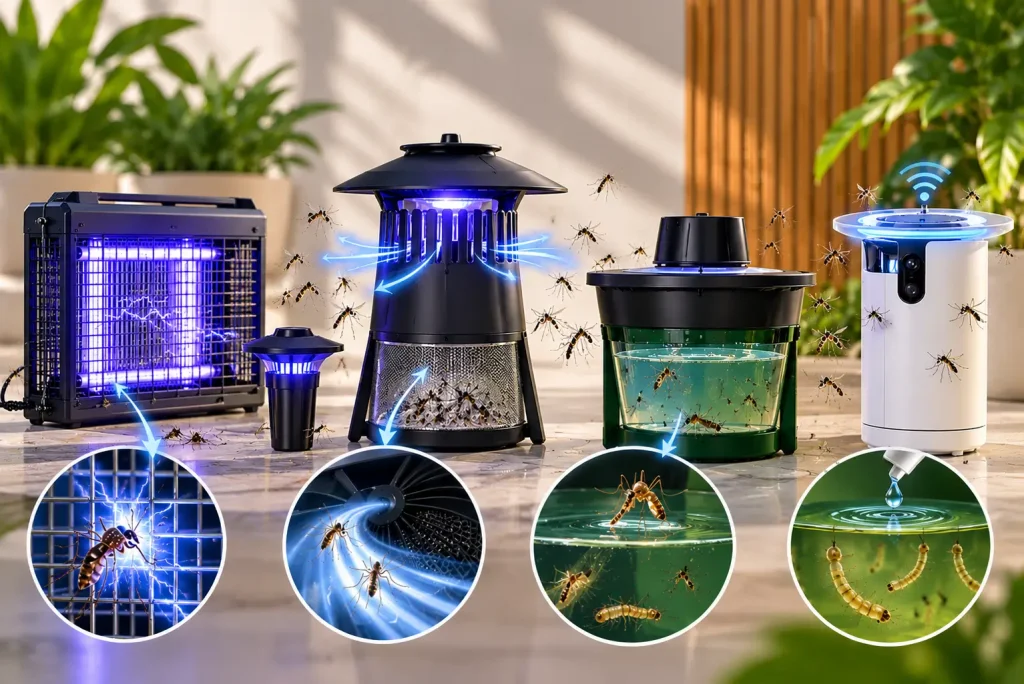
Once a mosquito reaches the trap, a capture mechanism holds it permanently. The mechanism determines effectiveness and maintenance needs. Four methods dominate.
- Suction fans: A quiet fan pulls the mosquito into a mesh bag, where it dehydrates within hours.
- Sticky surfaces: Adhesive boards hold mosquitoes in contact.
- Water-based capture: Mosquitoes enter a chamber and drown or stick to the surface. AGO traps use this design.
- Larvicides and growth regulators: Bti (Bacillus thuringiensis israelensis) and pyriproxyfen stop larvae from becoming adults.
How to Make a Mosquito Trap with a Bottle?
To make a mosquito trap with a bottle, cut a 2-liter plastic bottle in half, fill the bottom with sugar, warm water, and yeast, then invert the top half as a funnel. The yeast releases CO₂, which lures female mosquitoes into the bottle, where they cannot escape.
- Cut the bottle about one-third of the way down from the top.
- Mix 50 grams of brown sugar with 250 ml of warm water in the bottom half.
- Let it cool, then add 1/4 teaspoon of yeast without stirring.
- Flip the top half upside down and fit it into the bottom like a funnel.
- Wrap the bottle in black paper, leaving the top open.
- Place it in a shaded corner, at least 10 meters from where you sit.
- Replace the mixture every 2 weeks.
Homemade Mosquito Traps: Step-by-Step DIY Guide
Homemade traps cost little and reduce mosquitoes in small areas such as balconies and patios. They catch far fewer mosquitoes than professional systems, so use them as a supplement, not a replacement. Each recipe below uses household items.
DIY 1: Sugar and Yeast Bottle Trap
Yeast ferments sugar and releases CO₂, which attracts female mosquitoes. This is the most popular homemade mosquito trap.
- Cut a 2-liter plastic bottle in half, about one-third from the top.
- Mix 50 grams of brown sugar with 250 ml of warm water in the bottom half. Stir until the sugar dissolves.
- Let the water cool, then add 1/4 teaspoon of yeast. Do not stir.
- Flip the top half upside down and fit it into the bottom half like a funnel.
- Wrap the bottle in black paper or cloth, leaving the top open.
- Place it in a shaded corner, away from where you sit.
- Replace the mixture every 2 weeks.
DIY 2: Apple Cider Vinegar Trap
The sweet, fermented smell draws mosquitoes and fruit flies. Soap breaks the surface tension, so insects sink.
- Pour 100 ml of apple cider vinegar into a bowl or jar.
- Add 1 tablespoon of sugar and stir.
- Add 4 to 5 drops of dish soap and mix gently.
- Place the bowl near windows or plants.
- Replace the liquid every 3 to 4 days.
DIY 3: Soapy Water Trap
Mosquitoes land on still water, and soap makes them sink.
- Fill a shallow dark bowl with water.
- Add 1 tablespoon of dish soap.
- Place a lit candle or small lamp nearby at night, since the light draws insects.
- Empty and refill it daily.
DIY 4: Hay Infusion Ovitrap
This trap targets egg-laying Aedes. Handle it with care, because a neglected ovitrap becomes a breeding site.
- Fill a black 1-liter container with water.
- Add a handful of dry hay, grass, or leaves and let it sit for 5 days.
- Place the container under a plant or in a shaded corner.
- Cover the top with fine mesh so adults cannot escape, or empty it every 5 to 7 days.
DIY 5: Fan and Filter Trap
A box fan pulls in mosquitoes that follow your scent or CO₂. A filter at the back catches them.
- Mount a 20-inch box fan upright on a stand.
- Tape a fine-mesh furnace filter or a sticky sheet to the back.
- Run it at night near the area you want to protect, at least 10 meters from seating.
- Replace the filter weekly.
Limits of Homemade Traps
Homemade traps lack the steady CO₂ flow and lure blends of commercial units. They protect small spaces and give no measurable control over a villa compound. Use them alongside source reduction, and call professionals if mosquitoes persist.
Latest Technologies in Mosquito Trapping Systems
Smart mosquito traps in Dubai now combine capture with real-time data. This turns a trap into a monitoring tool as well as a control tool.
- IoT sensors: Connected traps send temperature, humidity, and catch data to a cloud platform every few hours.
- AI species identification: Optical sensors and cameras recognize Aedes, Culex, and Anopheles by wingbeat frequency and body shape.
- Automated counting: Infrared beams count each insect that enters, which removes manual counting errors.
- Attractive toxic sugar baits (ATSB): These baits lure mosquitoes to feed on sugar laced with a low-risk toxin.
- Solar and battery power: Outdoor units run for weeks without mains power.
- Remote alerts: The system notifies technicians when catch numbers pass a set threshold.
These tools support mosquito monitoring in Dubai for hotels, residential communities, construction sites, and golf courses. Trap data tells technicians where to focus treatment. That approach cuts chemical use and speeds up response times.
Mosquito Trap Solutions Dubai: Why Local Conditions Matter
Dubai’s climate shapes mosquito activity. Summer heat above 40°C slows outdoor activity, but irrigation, air-conditioning condensate, and ornamental water features keep breeding sites active all year. Activity usually rises in the cooler, more humid months from October to April.
Aedes aegypti, the dengue vector, breeds in small containers like plant saucers, drains, and tyres. Culex species thrive in stagnant, nutrient-rich water. Effective mosquito trap solutions in Dubai must target both groups.
How to Set Up a Mosquito Trap?
Placement affects results more than the brand of the trap. Follow this how-to for any trap type.
- Inspect your property: Find standing water in pots, gutters, drains, and ponds. Empty or treat every source.
- Choose the trap type: Use adult traps for biting problems and ovitraps for Aedes control.
- Pick the right spot: Place the trap 10 to 15 meters from where people sit, in shaded, humid areas near vegetation.
- Set the right height: Place Aedes traps 30 to 60 centimeters above the ground. Culex traps work better at 1 to 1.5 meters.
- Activate the lure: Install a fresh octenol or lactic acid cartridge and start the CO₂ source.
- Run it continuously: Keep the trap on 24 hours a day, since mosquitoes feed at dawn and dusk.
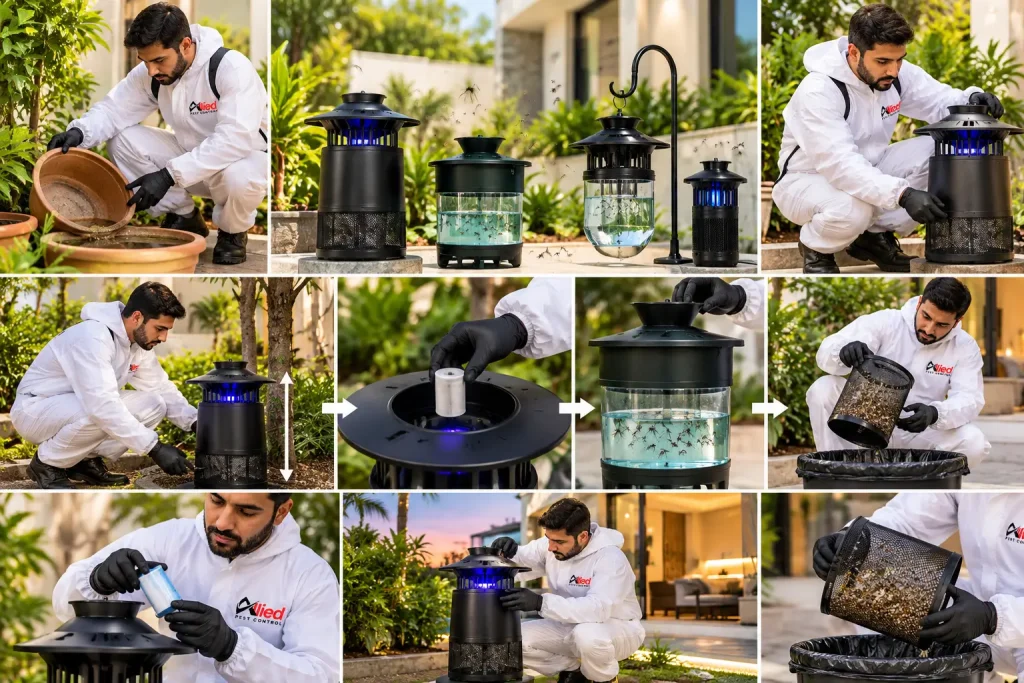
- Empty and clean: Service the trap weekly and replace lures on schedule.
Mosquito Trap Maintenance Checklist
- Empty the collection bag or replace the sticky board every 7 to 14 days
- Replace the lure cartridge every 3 to 4 weeks
- Refill the CO₂ cylinder as the manufacturer directs
- Clean the fan intake and mesh monthly
- Check batteries or solar panels weekly
- Log the number of mosquitoes caught each week
- Remove standing water around the property every 5 to 7 days
Tips for Better Mosquito Control in Dubai
Traps work best as part of a wider mosquito control plan. These tips raise their performance:
- Place two or more traps around a villa to create a capture perimeter.
- Trim vegetation, since mosquitoes rest in dense shade during the day.
- Fix leaking taps and irrigation lines that create puddles.
- Add larvicide to ponds and decorative water features.
- Combine traps with professional mosquito pest control in Dubai for barrier treatments.
- Review trap data monthly and move units where catches run highest.
Professional mosquito control solutions in Dubai combine trapping, larviciding, and source reduction. Allied Pest Control follows this integrated approach. Technicians inspect your property, install the right traps, and monitor results over time. Explore our full range of mosquito pest control Dubai services.
Conclusion
Mosquito trap solutions work because they copy the signals mosquitoes follow: CO₂, heat, moisture, and scent. Suction fans, sticky boards, and gravid ovitraps then remove them. Homemade traps help in small spaces, while smart sensors and AI identification make professional treatment precise.
Dubai’s year-round breeding sites make professional mosquito trapping systems a practical investment. Success depends on correct placement, regular maintenance, and monitoring. To protect your villa, hotel, or commercial property, contact Allied Pest Control for an inspection and a custom mosquito control plan.
Frequently Asked Questions About Mosquito Trap Solutions
What are the different types of mosquito traps?
The main types are CO₂ suction traps, CDC light traps, sticky traps, ovitraps, gravid traps, smart IoT traps, and electric zappers. Suction and gravid traps give the best results against biting species.
What colors of light attract mosquitoes most?
Red and orange light attract mosquitoes most, followed by cyan, according to a 2022 University of Washington study. This effect occurs only when CO₂ is present. Green, blue, and purple light barely attract them.
Do homemade mosquito traps work?
Yes, in small spaces. Sugar-yeast and vinegar traps catch some mosquitoes, but far fewer than commercial CO₂ traps. Use them with source reduction.
Do mosquito traps really work?
Yes. Traps that use CO₂, heat, and chemical lures capture large numbers of female mosquitoes. They work best alongside professional treatment.
How far does a mosquito trap reach?
Most residential traps cover 100 to 400 square meters, depending on the model and surroundings. Wind and vegetation affect this range.
What is the best bait for a mosquito trap?
CO₂ combined with octenol or lactic acid attracts the widest range of species. Ovitraps use hay infusion water for egg-laying Aedes females.
Are mosquito traps safe for children and pets?
Yes. Most traps use no insecticide on exposed surfaces. Keep CO₂ cylinders, yeast mixtures, and lure cartridges out of reach.
How often should you service a mosquito trap?
Service traps every 7 to 14 days and replace lures every 3 to 4 weeks. Homemade traps need fresh mixtures every 3 days to 2 weeks.