
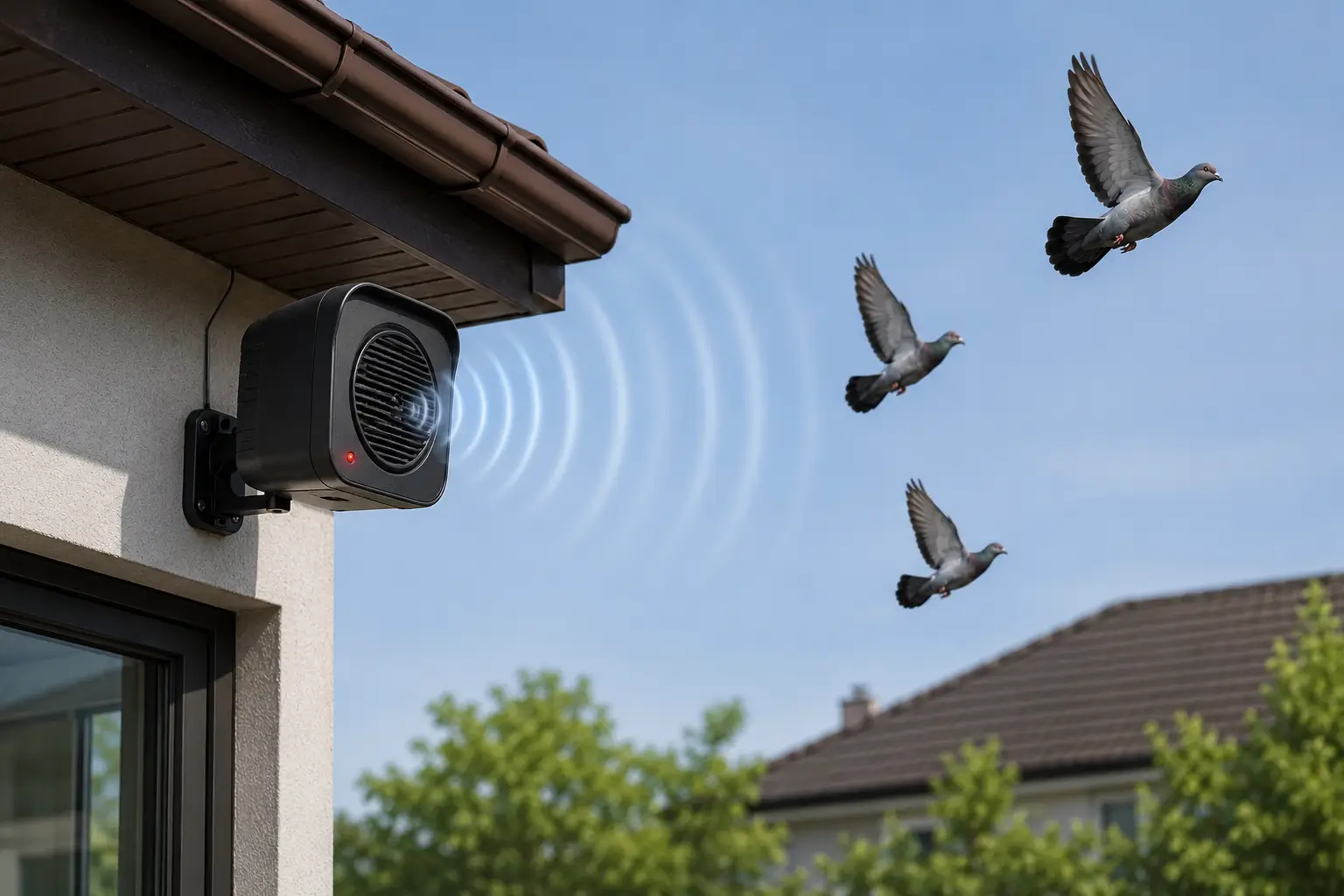
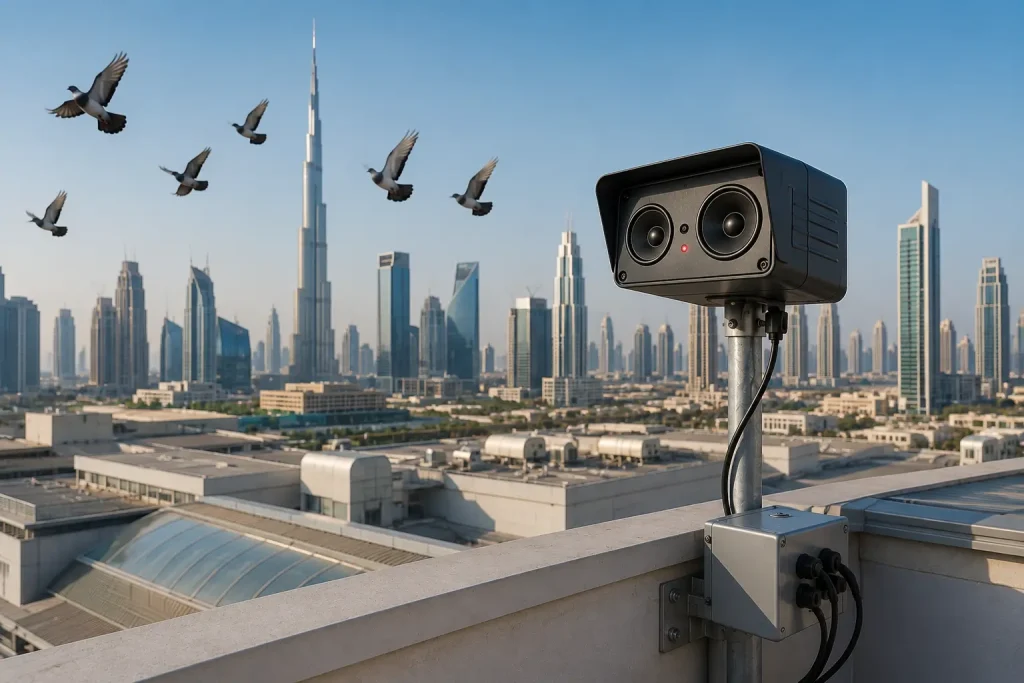
Bird pressure costs industries billions annually, from crop losses on farms to contamination risks in food facilities and wildlife strike hazards at airports. In fast-growing urban environments like Dubai, where high-rise buildings and warehouses attract pigeons year-round, effective bird control in Dubai has become a critical priority.
Traditional methods like netting and spikes are limited in scale and labor-intensive. New electronic bird control methods offer automated, humane, and highly scalable alternatives that run continuously and adapt to bird behavior.
Quick Answer: What are New Electronic Bird Control Methods
The latest methods include ultrasonic repellers, sonic and bioacoustic deterrents, laser systems, motion-activated devices, drone hazing, AI-powered monitoring, solar-powered units, LED visual deterrents, IoT-connected networks, and electric track systems.
These technologies are humane, automated, and effective across commercial, agricultural, and industrial environments.
Understanding Modern Electronic Bird Control Systems
What Are Electronic Bird Control Systems?
Electronic bird control systems are devices that repel birds using sound, light, motion, or mild electrical stimulus without causing harm. They actively respond to bird presence and operate autonomously, unlike passive barriers like nets or spikes.
How Electronic Bird Deterrent Technology Works
These systems trigger birds’ natural avoidance instincts through distress calls, threatening light patterns, or mild physical stimuli. The goal is consistent disruption, making a site so uncomfortable that birds permanently relocate.
Latest Electronic Methods for Bird Control
1. Ultrasonic Bird Repellers
Ultrasonic repellers emit high-frequency sound waves above 20 kHz that cause discomfort in birds but are inaudible to humans. They work best in enclosed spaces like warehouses, hangars, and covered car parks.
2. Sonic and Bioacoustic Bird Deterrent Systems
Sonic systems broadcast species-specific distress calls and predator sounds, triggering the bird’s natural flight response. Bioacoustic systems use recordings matched to the target species, making them far more effective than generic noise devices.
3. Laser Bird Deterrent Systems
Automated laser units sweep a moving green beam across a target area, and birds perceive the approaching light as a physical threat and take flight. They produce no noise, work well at dusk and dawn, and show low habituation rates compared to sound-based systems.
4. Motion-Activated Electronic Repellers
PIR and microwave sensors detect bird movement and instantly trigger a burst of sound, light, or water. The surprise response conditions birds to avoid the area, making it the perfect solution to protect your Dubai restaurant’s outdoor area from birds. Ideal for targeted spot protection on rooftops, docks, and solar panels.
5. Drone-Based Bird Management Systems
UAVs patrol large open areas and disperse bird flocks through physical presence and movement, mimicking natural predator behavior. They are widely used at airports for wildlife strike risk reduction and on large agricultural operations.
6. AI-Powered Smart Bird Monitoring Systems
Camera networks and acoustic sensors feed data into an AI engine that identifies bird species, assesses risk, and automatically triggers the appropriate deterrent response in real time. Particularly valuable at airports, food processing plants, and large commercial campuses.
7. Solar-Powered Electronic Bird Repellers
Solar-powered units run sonic, ultrasonic, or visual deterrents entirely off-grid using photovoltaic panels. This makes them ideal for remote farms, vineyards, and rural solar installations where external power is unavailable.
8. LED Visual Deterrent Systems
Flashing and strobing LED systems, including UV-spectrum lights visible to birds but not humans, create a threatening visual environment that discourages landing and roosting. They are most effective in low-light conditions and enclosed spaces.
9. IoT-Enabled Bird Control Networks
IoT platforms connect multiple deterrent devices across a site into a single cloud-managed system. Operators monitor activity data, adjust settings remotely, and receive real-time alerts, enabling data-driven optimization of deterrence performance.
10. Electric Track Bird Deterrent Systems
Low-voltage electrified tracks installed on ledges, beams, and roof edges deliver a brief, harmless shock when a bird lands, conditioning them to permanently avoid treated surfaces. Often paired with a bird wire system in Dubai, tensioned stainless steel wires physically prevent landing for a combined passive-and-active deterrent layer.
Benefits of Electronic Bird Control Systems
- Humane: No birds are harmed; all systems deter rather than injure.
- Automated: Most systems operate continuously without daily human intervention.
- Scalable: Coverage ranges from a single rooftop to multi-site operations spanning thousands of acres.
- Data-driven: IoT and AI systems track activity and optimize performance over time.
- Regulatory-friendly: Electronic deterrents comply with wildlife protection laws where lethal methods cannot.
Factors to Consider Before Choosing an Electronic Bird Control System
Bird Species
Different species respond differently. Pigeons respond to electric tracks and lasers, starlings to bioacoustic calls, and gulls require varied multi-technology approaches. Accurate species identification is essential before system selection.
Site Assessment
Coverage area, structure type, power availability, and proximity to neighbors all shape technology choice. In Dubai’s high-density urban environment, rooftop and ledge protection often combines a bird wire system with electronic deterrents for maximum effectiveness.
Budget
Entry-level sonic units cost under AED 1,835, while enterprise AI-IoT networks can exceed AED 367,000. Factor both upfront costs and ongoing maintenance expenses into the total investment calculation.
Maintenance
All electronic systems need periodic inspection and recalibration. Sonic speakers, laser lenses, sensor calibration, and electric track cleaning all require scheduled attention to maintain long-term effectiveness.
Regulatory Considerations
Certain bird species carry legal protections that govern permissible deterrent methods. Always verify local and national wildlife regulations before deploying any electronic bird control program.
Challenges and Limitations
Habituation
Birds are highly adaptable and learn to ignore predictable, repeated stimuli. Randomizing patterns, rotating technologies, and combining multiple deterrent types are the most effective countermeasures.
Environmental Factors
Wind reduces sonic range, full sunlight limits laser effectiveness, and poor weather grounds drone programs. Site-specific environmental conditions must always be assessed during system design.
Cost and Maintenance
High-performance AI and IoT systems involve significant capital costs and ongoing maintenance contracts. Under-maintained systems lose effectiveness quickly, negating the initial investment.
Future Trends in Electronic Bird Control
Artificial Intelligence
Next-generation AI platforms will move into predictive modeling, anticipating flock movements using weather data, migration patterns, and historical activity logs to pre-deploy deterrents before birds arrive.
Machine Learning Optimization
Self-learning systems will automatically adjust timing, intensity, and technology selection based on real-world response data, continuously minimizing habituation without manual reconfiguration.
Robotics and Autonomous Monitoring
Autonomous patrol robots and fully autonomous monitoring networks using edge computing are in active development. They will make real-time deterrent decisions without cloud latency and redefine large-site bird management.
Best Practices for Maximum Effectiveness
- Combine technologies: Address multiple sensory channels and reduce habituation.
- Randomize deterrent patterns: Predictable systems are quickly ignored by birds.
- Reassess seasonally: Bird pressure and species composition change throughout the year.
- Install before nesting season: Clearing established nests is far harder than preventing them.
- Document and review performance data: IoT dashboards and activity logs reveal what’s working.
- Consult a wildlife management professional: Specialists like Allied Pest Control assess your site and recommend the right combination of electronic and physical systems, including bird wire systems, for long-term results.
Conclusion
New methods for bird control using electronic systems have made bird management more precise, automated, and humane than ever before. The most effective programs combine multiple technologies and adapt to seasonal pressure for lasting results. If you are based in the UAE, Allied Pest Control offers professional bird control in Dubai using laser units, bioacoustic devices, bird wire systems, and electric track installations, all tailored to your site.
Frequently Asked Questions
Are electronic bird control systems humane?
Yes. All listed systems deter birds through discomfort or instinctive behavioral response without causing physical injury, and they are widely accepted as humane and wildlife-friendly.
How effective are ultrasonic bird repellers outdoors?
Significantly less effective. Sound waves dissipate rapidly in open air, and ultrasonic repellers perform best in enclosed spaces like warehouses, car parks, and aircraft hangars.
What is the best electronic bird control method for airports?
AI-powered monitoring integrated with drone hazing and bioacoustic deterrents works best. Multi-technology programs meet aviation wildlife management standards most reliably.
How much do commercial electronic bird control systems cost?
In Dubai, basic ultrasonic units typically cost AED 150–3,000, while advanced laser, shock-track, and AI-based solutions range from AED 10,000 to AED 500,000+, depending on coverage area and installation requirements.
Do birds habituate to electronic deterrents?
Yes, habituation is a real limitation. Randomizing patterns, rotating technologies, and combining multiple methods keep habituation rates low over the long term.
Can electronic bird control be used on solar panels?
Yes. Solar-powered laser deterrents and motion-activated repellers are widely used on solar farms, protecting panel arrays without requiring external power.