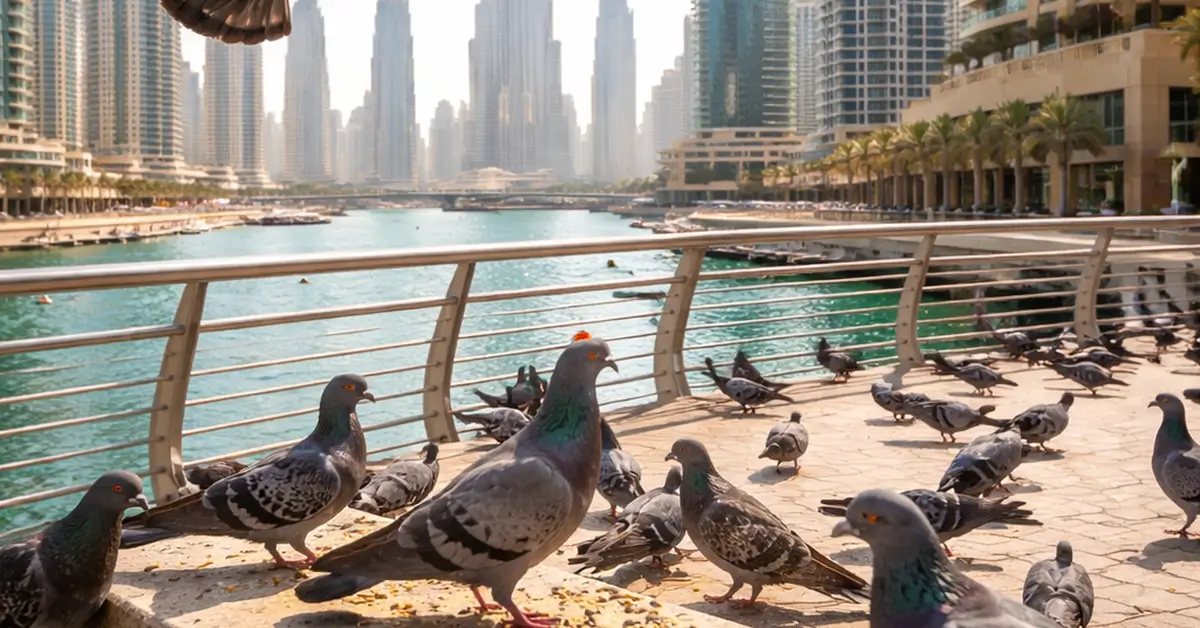
Pigeons in Dubai keep coming back because balconies, rooftops, and AC ledges offer safe nesting spots along with easy access to food and water. Once they find a secure place, they often return repeatedly and can quickly multiply. Allied Pest Control provides effective solutions for bird control in Dubai, including bird spikes, netting, and advanced deterrent systems to stop pigeons permanently.
Why Does Dubai Have a Pigeon Problem?
Dubai’s urban environment is, unintentionally, a perfect habitat for pigeons. The city offers everything a pigeon needs: year-round warmth, minimal natural predators, ledges and AC units that mimic cliff faces (pigeons’ natural nesting terrain), and an abundant food supply from outdoor dining, open bins, and residents who feed birds.
The feral pigeon population has grown significantly over the past two decades alongside rapid urbanization. High-rise towers in areas like Downtown Dubai, Deira, and Al Barsha create thousands of sheltered ledges, drainage channels, and mechanical rooftop units, all ideal nesting zones. Unlike in colder climates where winter slows breeding, Dubai’s mild winters allow pigeons to breed almost year-round, producing 6 to 8 clutches of eggs annually per pair.
Common Pigeon Nesting Habits You Need to Understand
To stop pigeons permanently, you need to think like one. Pigeons are creatures of habit; they return to the same nesting site repeatedly, sometimes for years, even after the original nest is removed. Here is what drives their behavior:
Pigeons nest in pairs: A male and female select a sheltered spot together. The female lays 2 eggs per clutch, and both parents incubate them for 17–19 days. Chicks fledge in 25–32 days, and the cycle begins again almost immediately.
They prefer elevated, sheltered spots: AC condenser units, window ledges, parapet walls, satellite dish brackets, and false ceiling gaps are the top nesting locations in Dubai apartments and villas. These spots mimic the rocky cliff faces pigeons evolved to nest on.
Nesting material accumulates fast: Pigeons build loose nests from twigs, wire, plastic, and debris. In Dubai’s dusty environment, nests collect sand, feathers, and droppings rapidly creating a biohazard within weeks.
Pigeon droppings are corrosive: Pigeon uric acid (the white part of droppings) has a pH of 3–4.5. Over time, it damages paint, concrete, waterproofing membranes, and metal, a real maintenance cost for Dubai property owners.
They communicate location to other pigeons: Once a pigeon establishes a nesting site, it attracts others. A single pair can grow into a flock of 20–30 birds within one breeding season if left unmanaged.
Why Balconies in Dubai Attract Pigeons
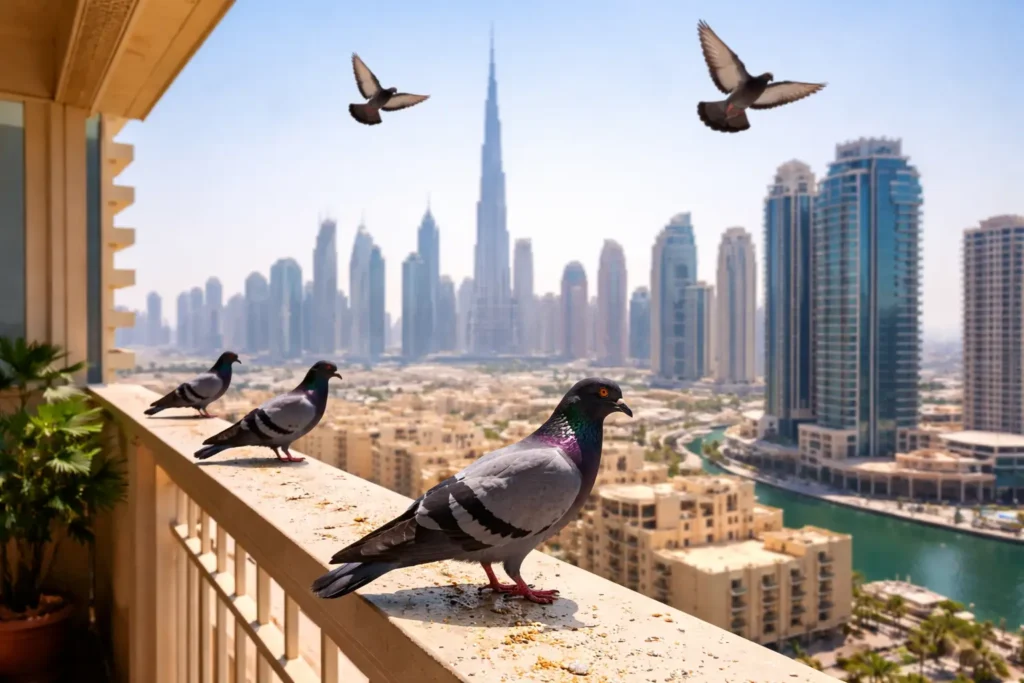
Balconies in Dubai often attract pigeons because they provide safe ledges for roosting, shelter from heat, and easy access to food and water sources nearby. For effective bird control in Dubai, Allied Pest Control helps prevent pigeons from nesting and returning to residential balconies. Several specific features make them irresistible:
Shelter from wind and sun: Dubai’s summer temperatures exceed 45°C. Balcony ceilings and walls provide shade that pigeons actively seek during peak heat hours (11am–3pm). North-facing and partially enclosed balconies are especially attractive.
No human activity for long periods: Many Dubai residents spend limited time on their balconies especially during summer. Pigeons monitor human activity patterns. A quiet balcony signals safety to a scouting pigeon within days.
Standing water: Air conditioning drainage pipes frequently drip onto balcony floors. Even a small puddle provides enough water for a pigeon colony. This is one of the most overlooked attractants in Dubai apartments.
Food left outdoors: Pet food bowls, fruit left on tables, birdseed put out by well-meaning residents, and even open compost attract pigeons directly. Once a food source is found, pigeons return multiple times daily and bring others.
Gaps around AC units and railings. The space between an AC condenser and the wall, or behind a railing bracket, is exactly the sheltered cavity pigeons look for when nest-building. These gaps are common in older Dubai building stock.
Learn more about: How to Stop Birds from Coming to your Balcony?
How to Stop Pigeons Permanently?
To stop pigeons permanently, block their access points with bird spikes, netting, or mesh on ledges, balconies, and rooftops. Remove food sources, standing water, and nesting spots to prevent them from returning. Here we provide a step-by-step detailed guide to help you prevent pigeons permanently.
Step 1: Remove the Nest and Clean the Area Immediately
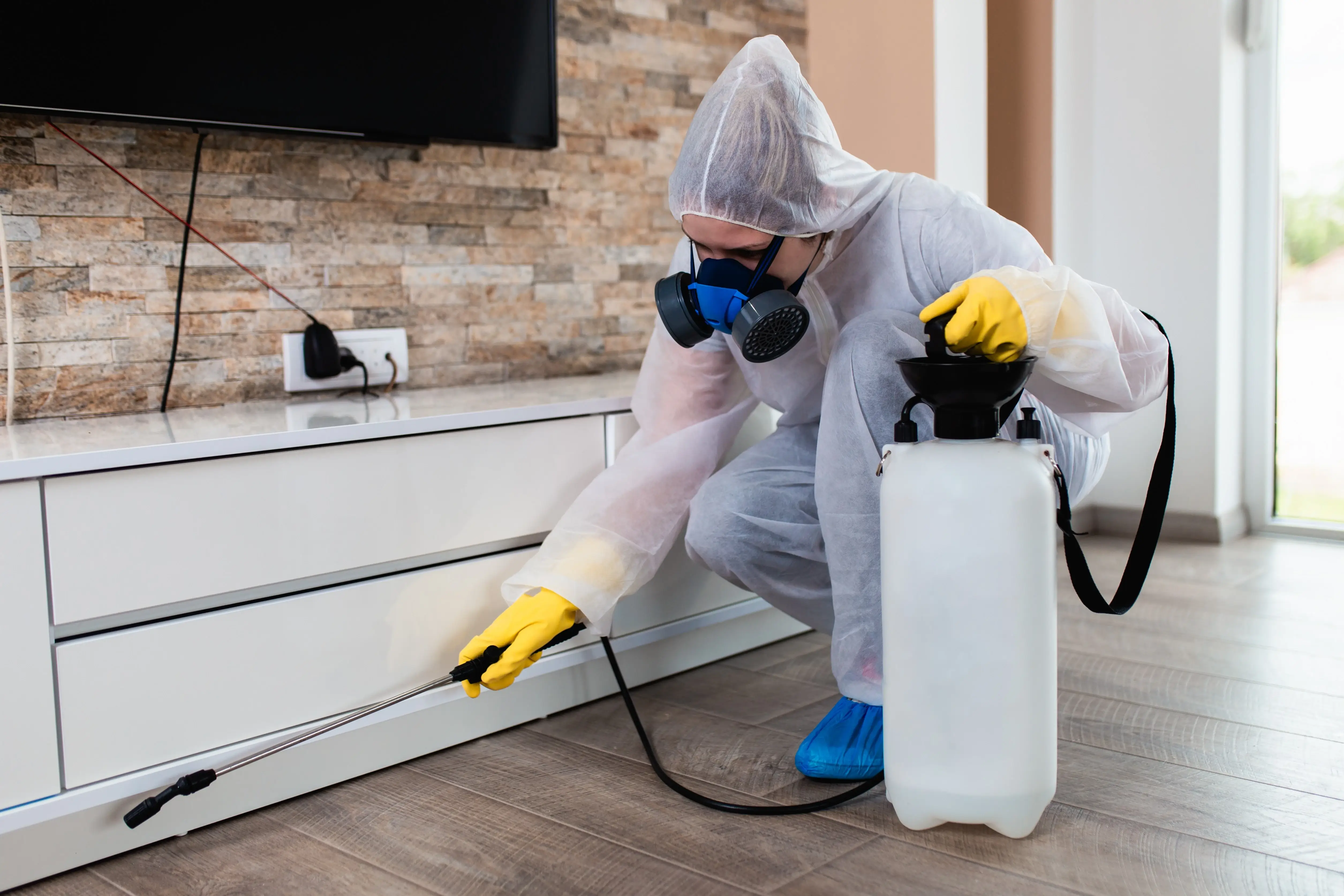
Never leave an existing nest in place. Wear gloves and a face mask pigeon droppings carry Histoplasma, Cryptococcus, and Salmonella bacteria. Remove all nesting material, eggs, and debris. Spray the area with a disinfectant solution (diluted bleach or a commercial avian disinfectant). Allow to dry fully before installing any deterrents.
Critical point: If you only install spikes without removing the nest and cleaning the scent, pigeons will return and build around the deterrent.
Step 2: Install Bird Spikes on All Landing Surfaces
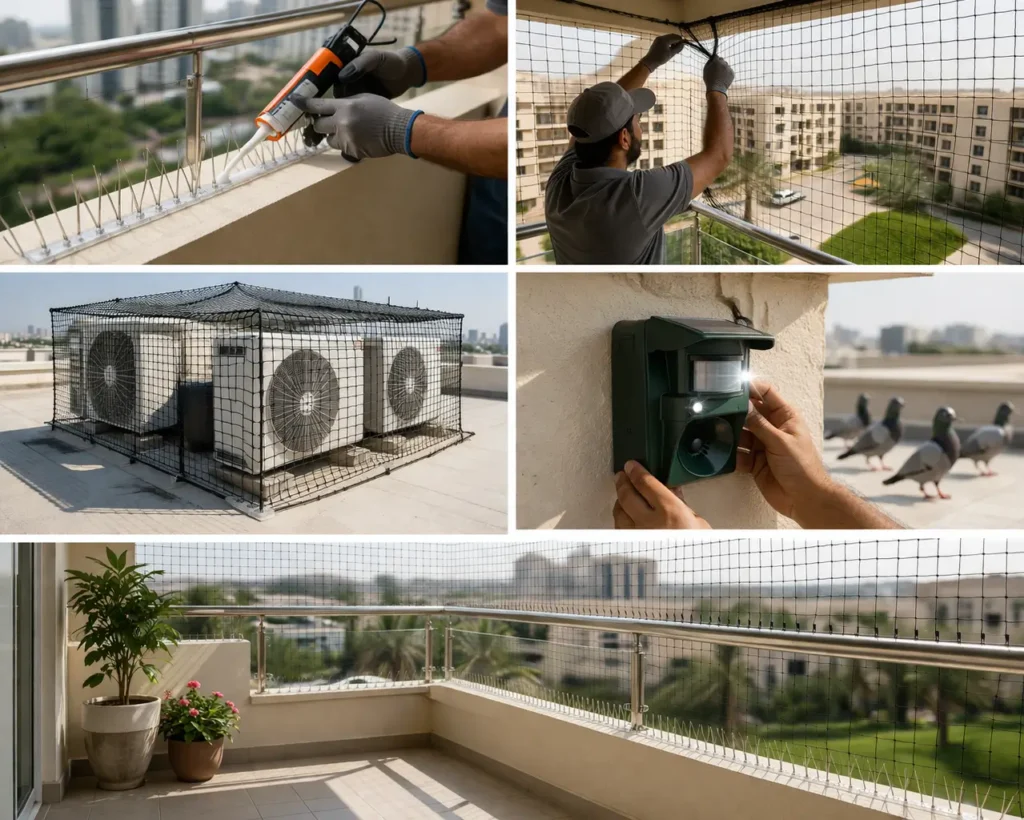
Bird spikes are the most cost-effective long-term deterrent for Dubai balconies. Use stainless steel spikes (polycarbonate spikes degrade in Dubai’s UV-intense sunlight within 12–18 months). Install on every horizontal surface: railing tops, AC unit tops, ledges, parapet walls, and satellite dish brackets.
Cover 100% of the surface pigeons will find any uncovered gap and use it. A 30 cm gap in spike coverage is enough for a pigeon to squeeze in and restart nesting.
Step 3: Install Anti-Bird Netting for Fully Enclosed Protection
For balconies with persistent infestations or for property owners who want complete exclusion, anti-bird netting is the gold standard. A UV-stabilized polyethylene net installed across the full balcony opening physically prevents any pigeon from entering.
Netting must be tensioned correctly loose netting sags and creates pockets where birds get trapped, which creates a different problem. Professional installation is strongly recommended for nets larger than 10 square meters.
Step 4: Eliminate All Food and Water Sources
Fix all AC drainage drips that create standing water on balcony floors. Remove pet food bowls after each meal. Never feeding pigeons is illegal under Dubai Municipality regulations and directly grows the local population. Clear outdoor tables of food scraps after every use.
If neighbors are feeding pigeons, report it to building management. One feeding source within 200 meters will undermine every deterrent you install.
Step 5: Apply Bird Gel Repellent in Gaps and Corners
Bird gel repellent (a non-toxic, sticky polybutylene gel) applied in gaps around AC units, behind railing brackets, and in drainage channels creates a tactile deterrent pigeons dislike landing on. It remains effective for 6–12 months in Dubai’s climate before requiring reapplication.
Do not apply gel in open areas; it collects dust and debris quickly in Dubai’s sandy environment and loses effectiveness within weeks when exposed to direct sun and wind.
Step 6: Schedule a Professional Inspection Every 6 Months
Bird control in Dubai requires ongoing monitoring, not a one-time fix. Pigeons adapt. New birds scout old territories. Building changes create new gaps. A professional bird control inspection every 6 months catches new nesting activity before it becomes an infestation.
Long-Term Prevention Tips for Dubai Residents
These habits, maintained consistently, prevent pigeons from ever reestablishing:
- Check your balcony weekly: for feathers, droppings, or nesting material these are early warning signs before a nest is built.
- Seal all gaps larger than 3 cm: around AC units, pipes, and cable entry points with wire mesh or expanding foam.
- Use balcony plants strategically: dense planters along railings reduce landing space without any installation.
- Coordinate with neighbors and building management: pigeon control on one floor is ineffective if upper and lower floors remain unmanaged.
- Report feeding activity: to Dubai Municipality’s Environment Department (800-900) they handle community-level pigeon issues.
How Long Does It Take to Stop a Pigeon Infestation?
With a complete approach nest removal, surface cleaning, spike installation, netting, and food source elimination most Dubai balconies see a significant reduction in pigeon activity within 2–3 weeks. Full deterrence, where pigeons stop returning entirely, typically takes 4–6 weeks as the birds exhaust their attempts to reassess the site and move on.
Partial measures (spikes only, or cleaning only) rarely produce permanent results. Pigeons are persistent; they will test every deterrent repeatedly until they find a gap.
Why are Pigeons Coming and How to Stop Them?
- Pigeons return because your balcony offers shelter, warmth, and food access.
- Female pigeons lay eggs every 6 weeks and nests multiply fast if ignored.
- Bird spikes, anti-bird netting, and gel repellents are the three most effective deterrents.
- Clean nesting debris immediately pigeons return to the same spot for years.
- Dubai Municipality regulations require residents to manage pigeon infestations actively.
- Professional bird control in Dubai is recommended for rooftops and large balconies.
- Prevention is permanent only when food sources and nesting spots are both eliminated.
Conclusion
Pigeons keep coming back to Dubai balconies and rooftops because the urban environment gives them exactly what they need: shelter, warmth, water, and food. Permanent bird control in Dubai requires removing all four of these attractants simultaneously while physically excluding birds from nesting surfaces.
For property owners dealing with large-scale infestations, rooftop colonies, or multi-floor building problems, Allied Pest Control provides professional bird control solutions across Dubai including anti-bird netting installation, spike fitting, gel application, and scheduled monitoring programs certified under Dubai Municipality guidelines.