
Bird infestations impact businesses in Dubai by triggering hygiene violations, costly regulatory fines, and lasting damage to brand reputation. Pigeons and mynas contaminate food preparation areas, block ventilation systems, and leave acidic droppings that corrode building materials. Dubai Municipality enforces strict pest control regulations requiring all commercial premises to maintain documented, professional pest management programs or face license suspension.
Quick Answer
- Identify bird species present and assess the full extent of infestation.
- Document all evidence before contacting a licensed pest control company.
- Hire a Dubai Municipality-approved contractor for compliant bird control.
- Install physical deterrents: spikes, nets, wire systems, and bird gel.
- Remove all food waste and standing water that attract birds daily.
- Maintain a pest control log and inspection records at all times.
- Schedule professional re-inspections every 3 months minimum.
What Is a Bird Infestation in a Commercial Setting?
A bird infestation in a commercial setting occurs when wild bird species most commonly feral pigeons, house sparrows, and Indian mynas establish roosting or nesting colonies inside or directly on a business premises. In Dubai, these infestations affect rooftops, loading docks, kitchen exhaust vents, warehouse rafters, and open outdoor dining areas.
Dubai Municipality defines a pest infestation as any condition where the presence of animals creates a public health risk, structural hazard, or non-compliance with food safety standards. Bird infestations fall under this definition. The Dubai Municipality’s pest control regulatory framework requires all food-related and public-facing businesses to hold a valid pest control contract with an approved service provider.
Here’s a quick overview of primary risk and bird control methods:
| Business Type | Primary Risk | Control Method | Frequency | Time to Resolve |
| Restaurant / Café | Food contamination, hygiene fine | Exclusion netting + sanitation | Every 3 months | 3–7 days |
| Warehouse / Logistics | Product spoilage, slip hazards | Bird spikes + ultrasonic deterrents | Every 6 months | 5–10 days |
| Office Building | HVAC contamination, brand image | Bird wire systems + visual deterrents | Every 6 months | 2–5 days |
| Hotel / Hospitality | Guest complaints, reputation damage | Full exclusion + 24hr monitoring | Monthly | 7–14 days |
How Bird Infestations Impact Restaurants, Warehouses, and Offices
Restaurants and Food Service Businesses
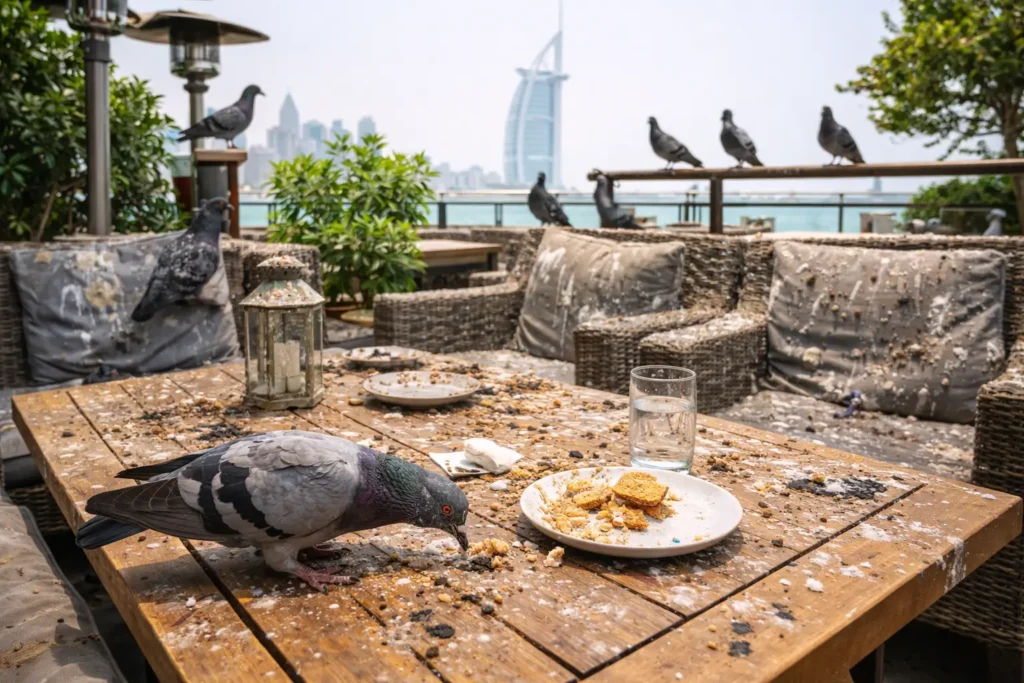
Birds infesting restaurant kitchens, terraces, or storage areas create a direct food safety emergency. A single pigeon deposits up to 12 kg of droppings per year, which carry Salmonella, E. coli, Histoplasma, and Cryptococcus pathogens. These contaminants reach food prep surfaces and serving areas within hours.
Dubai Municipality’s food inspection teams cite bird droppings as an automatic critical violation under the Food Safety Department’s grading system. A single failed inspection closes the establishment immediately costing the average Dubai restaurant AED 15,000–40,000 in lost daily revenue.
Warehouses and Distribution Centers
Birds enter warehouses through loading dock gaps, roof vents, and damaged cladding. Once inside, they roost in rafters and contaminate palletized goods and packaging below. Pigeon droppings carry a pH of 3–4.5, corrosive enough to damage electrical wiring, metal racking, and forklift components over 6–18 months.
Slip hazard incidents from accumulated droppings on warehouse floors account for a significant share of workplace injury claims in Dubai’s logistics sector. Under UAE Federal Law No. 8 of 1980 (Labour Law), employers are liable for unsafe working conditions created by pest infestations.
Office Buildings and Corporate Spaces
Birds roosting in HVAC intake vents push spore-laden dust directly into air circulation systems, creating indoor air quality violations. For large commercial towers in Dubai, this triggers mandatory HVAC deep cleaning at an average cost of AED 25,000–80,000 per system.
Beyond physical damage, bird infestations visible to clients destroy brand perception. A study by the British Pest Control Association found that 78% of customers would not return to a business where they observed a pest infestation. In Dubai’s competitive market, that reputational cost is irreversible without active remediation.
How Bird Infestations Impact Businesses: A Complete Guide
Step 1: Conduct a Full Site Assessment
Walk every level of the premises roof, plant room, loading area, kitchen, and storage with a torch and camera. Document every roosting point, entry gap, and dropping accumulation zone. Record bird species, estimated flock size, and nest locations. This evidence log protects you during any Dubai Municipality inspection.
Step 2: Engage a Dubai Municipality-Approved Pest Control Contractor
Only hire pest control companies holding a valid Dubai Municipality Pest Control License. Unlicensed contractors produce compliance certificates that inspectors reject. Verify the contractor’s license number on the Dubai Municipality official portal before signing any agreement. Allied Pest Control holds full DM approval and operates across all commercial sectors in Dubai.
Step 3: Install Physical Bird Deterrents
Physical exclusion is the most effective long-term bird control method. A licensed contractor installs the appropriate deterrent based on bird pressure and surface type:
- Stainless steel bird spikes ledges, parapet walls, signage
- Heavy-duty exclusion netting (50mm or 75mm mesh) warehouses, courtyards, canopies
- Tensioned wire systems facades, balustrades, solar panels
- Bird gel (polybutylene-based) narrow ledges, beams, signage frames
- Ultrasonic deterrent units large internal spaces, warehouses
Step 4: Remove Attractants and Seal Entry Points
Birds return to sites that provide food, water, and shelter. Remove all standing water from roof areas and AC drip trays within 24 hours. Seal waste disposal gaps, fit stainless steel mesh over all ventilation openings larger than 20mm, and enforce a zero-tolerance outdoor food waste policy. This step prevents re-infestation after deterrents are installed.
Step 5: Sanitize and Decontaminate Affected Areas
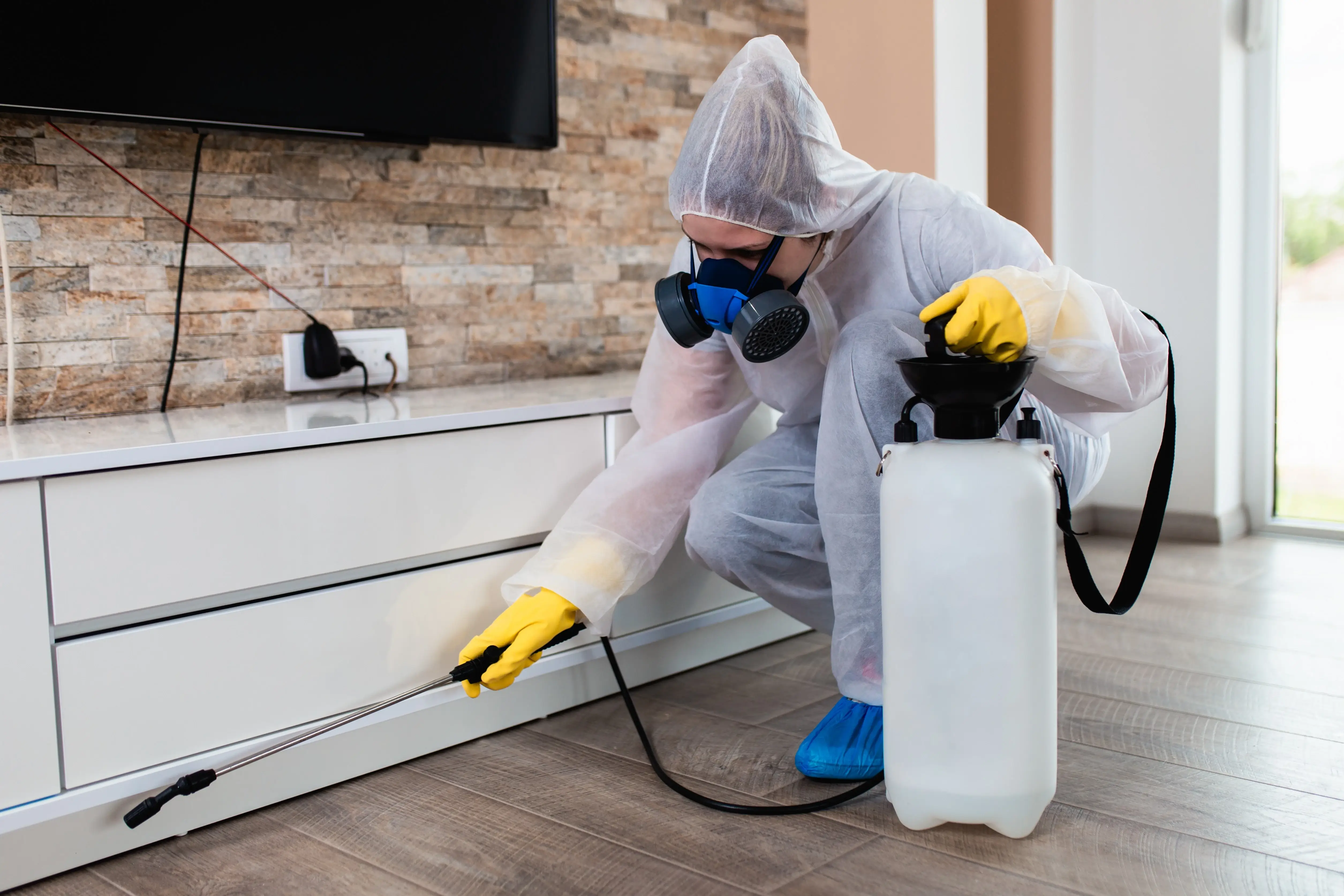
Professional biocidal sanitization of all droppings-affected surfaces is mandatory before a compliance certificate is issued. The contractor applies EN1276-certified disinfectants to eliminate Salmonella, E. coli, and fungal spores. Technicians use PPE Category 3 equipment during decontamination. Food business operators must document sanitization with a signed contractor report kept on-site.
Step 6: Obtain and Maintain Your Pest Control Compliance Certificate
Dubai Municipality requires food businesses to hold a current pest control service contract and display a valid completion certificate. The certificate must include the contractor’s DM license number, treatment date, method used, and next scheduled visit. Inspectors request this document during routine food safety audits. Failure to produce it results in immediate non-compliance notices.
Step 7: Schedule Ongoing Monitoring Visits
A one-time treatment does not maintain compliance. Dubai Municipality expects active, documented pest management programs. Schedule professional re-inspections every 3 months for food businesses, every 6 months for offices and warehouses, and conduct monthly internal checks using a signed log sheet. Keep all records on-site for a minimum of 2 years.
How Long Does Bird Infestation Treatment Take?
A standard bird infestation treatment for a restaurant or small commercial unit takes 1–3 days. Large warehouses or multi-floor office buildings require 5–10 working days. Severe infestations involving structural entry points may extend timelines by an additional 3–5 days for building repair coordination.
How Often Should Businesses in Dubai Address Bird Control?
Restaurants and food service businesses require professional bird control inspections every 3 months to maintain Dubai Municipality compliance. Warehouses, offices, and corporate buildings require inspections every 6 months. Properties near Dubai Creek, Deira, and outdoor market districts face higher re-infestation pressure and benefit from monthly monitoring during the October–April cool season.
Conclusion
Bird infestations in Dubai are a direct business risk not just a nuisance. They expose restaurants, warehouses, and offices to hygiene violations, regulatory fines, structural damage, and brand reputation loss. Dubai Municipality enforces a clear compliance framework, and businesses that fail to act proactively face closures, financial penalties, and customer trust erosion.
For professional Birds Control in Dubai that meets all Dubai Municipality and FERA compliance requirements, contact Allied Pest Control is a Dubai’s trusted licensed bird management specialists with over 15 years of commercial pest control experience.
Frequently Asked Questions
What is the fastest method to remove birds from a commercial property in Dubai?
The fastest bird removal method combines physical deterrent installation with same-day biocidal decontamination. A Dubai Municipality-approved contractor completes initial deterrent fitting and sanitization within 24–48 hours for most standard commercial units.
Can a bird infestation be resolved in a single treatment session?
A bird infestation can be significantly reduced in one professional session. However, full resolution requires 2–3 follow-up inspections over 30–60 days to confirm birds have not relocated to adjacent areas of the building.
What are the best bird control products for Dubai restaurants and warehouses?
The best bird control products are stainless steel bird spikes for ledges, 50mm heavy-duty exclusion netting for open spaces, and EN1276-certified biocidal disinfectants for decontamination. Ultrasonic deterrent units work effectively in enclosed warehouse environments with high ceilings.
What are the most common challenges businesses face with bird infestations in Dubai?
The most common challenge is recurring re-infestation after a single treatment, caused by failure to seal structural entry points and remove food attractants. The second most common challenge is using unlicensed contractors whose compliance certificates are rejected by Dubai Municipality inspectors.
What should a business owner do first when discovering a bird infestation?
The first step is to photograph and document all roosting sites, droppings accumulations, and structural entry points before any cleaning. This documentation protects the business during regulatory inspections and gives the pest control contractor a full site picture before treatment begins.